Short answer
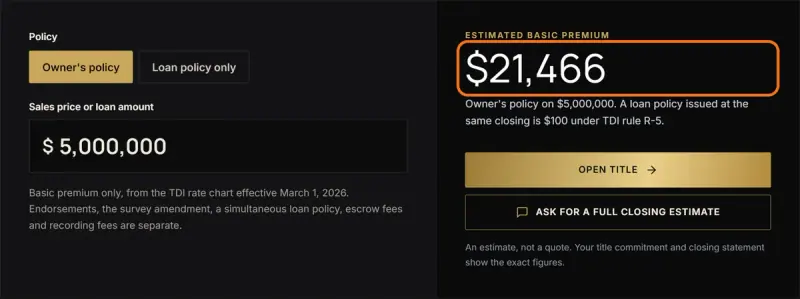
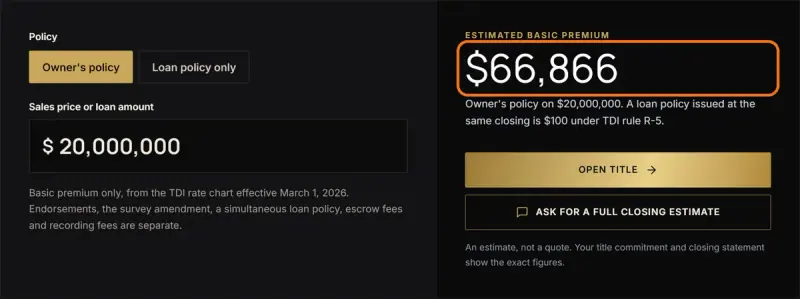
On a $5 million commercial purchase in Dallas, the owner's title policy premium is $21,466 under the Texas rates in effect since March 1, 2026. On a $20 million apartment purchase it is $66,866. The Texas Department of Insurance sets those premiums, so they are the same at every title company. A lender's policy issued at the same closing is $100, and the survey amendment and endorsements are added at rates the state also sets. Escrow fees and recording costs are separate and do vary.
This guide answers
- How much does commercial title insurance cost on a $5 million building in Dallas?
- What does title insurance cost on a $20 million apartment purchase in Dallas?
Key takeaways
- The 2026 Texas basic premium is $21,466 on a $5 million policy and $66,866 on a $20 million policy, at every title company.
- A loan policy issued with the owner's policy costs $100 under Rate Rule R-5, as long as the loan does not exceed the owner's policy amount.
- On commercial property the survey amendment adds 15 percent of the basic premium, and the T-19.1 endorsement adds 10 or 15 percent.
- The premium is paid once, at closing. It is not an annual cost.
- Escrow fees, the survey, tax certificates and recording fees are not set by the state, so ask for them in writing.
The short answer: $21,466 on $5 million, $66,866 on $20 million
If you are budgeting a commercial purchase in Dallas, the title insurance premium is one of the few closing costs you can calculate to the dollar before you call anyone. Texas sets it. Under the basic premium rates in effect since March 1, 2026, an owner's policy on a $5 million building costs $21,466, and an owner's policy on a $20 million apartment community costs $66,866.
Those figures are the same at every Texas title company. The Commissioner of Insurance fixes and promulgates title premium rates under Texas Insurance Code Section 2703.151, and no company may charge more or less for the same policy. Our article on whether title insurance rates are the same in Texas covers the rule and the ban on rebates in detail.
The basic premium is the starting point, not the whole title bill. A typical commercial closing adds three kinds of charges:
- State-set add-ons: the lender's policy, the survey amendment and the endorsements your lender or counsel asks for. These are also promulgated, so they are identical everywhere.
- Company-set charges: the escrow fee and smaller items such as tax certificates and delivery. These differ from one company to the next.
- Third-party costs: the survey itself and the county clerk's recording fees.
The rest of this guide works through the math for both deal sizes, then shows what moves the number up or down.
How the Texas rate chart works above $1 million
The premium depends on the policy amount. For an owner's policy that is normally the purchase price, and for a loan policy it is the loan amount. The Texas Department of Insurance publishes the basic premium rate schedule, and above $100,000 the premium comes from a formula: take the fixed amount for your bracket and add the bracket's rate for every $1,000 over the bottom of the bracket.
Texas basic premium brackets for commercial-size policies (rates effective March 1, 2026)
| Policy amount | Basic premium formula | Premium at the top of the bracket |
|---|---|---|
| $100,001 to $1,000,000 | $780 plus $4.94 per $1,000 over $100,000 | $5,226 at $1 million |
| $1,000,001 to $5,000,000 | $5,226 plus $4.06 per $1,000 over $1 million | $21,466 at $5 million |
| $5,000,001 to $15,000,000 | $21,466 plus $3.35 per $1,000 over $5 million | $54,966 at $15 million |
| $15,000,001 to $25,000,000 | $54,966 plus $2.38 per $1,000 over $15 million | $78,766 at $25 million |
| $25,000,001 to $50,000,000 | $78,766 plus $1.43 per $1,000 over $25 million | $114,516 at $50 million |
How to read this table: find the row your price falls in, subtract the bottom of that bracket from your price, multiply the remainder by the rate per thousand, and add the fixed amount. The rate per thousand falls as the deal gets larger, so a $20 million policy costs about three times what a $5 million policy costs, not four times.
Some common commercial price points, worked from the same chart:
- $2 million: $9,286
- $3 million: $13,346
- $5 million: $21,466
- $10 million: $38,216
- $15 million: $54,966
- $20 million: $66,866
- $25 million: $78,766
Two points keep these numbers honest. First, rates change by Commissioner's order. The current chart reflects a 6.2 percent reduction that took effect March 1, 2026, so a figure from an older chart or an old closing statement will be too high. Second, the rate that applies is the one in effect on the policy date. Our Texas title premium calculator runs the current chart for any amount.
Worked example: a $5 million building in Dallas
Take a $5 million purchase of an office, retail or flex building in Dallas County, financed with a $3.5 million loan. The buyer wants the survey coverage and the main commercial endorsement, which is the usual request on a deal this size.
Title premiums on a $5 million commercial purchase with a $3.5 million loan
| Item | Rule | Premium |
|---|---|---|
| Owner's policy, $5,000,000 | Basic rate (R-1) | $21,466.00 |
| Loan policy, $3,500,000, issued at the same closing | R-5 | $100.00 |
| Survey amendment on the owner's policy | R-16, 15 percent | $3,219.90 |
| T-19.1 endorsement on the owner's policy, bought with the survey amendment | R-29, 10 percent | $2,146.60 |
| Total of these four items | $26,932.50 |
What this means for you: the owner's policy is about 80 percent of the title premium on this deal, and the two optional items add roughly $5,400. The lender's policy is almost free when it is issued with the owner's policy, which is why buyers who finance rarely skip the owner's policy to save money. There is very little to save.
The lender will usually ask for its own endorsements on the loan policy. The loan-policy version of the restrictions, encroachments and minerals endorsement, the T-19, is priced under Rule R-29 at 10 percent of the basic rate for commercial land. Flat-rate endorsements such as the T-23 access endorsement and the T-25 contiguity endorsement are $100 each. Which ones apply depends on the property and the lender, so treat the table as the core and expect a few smaller lines around it. Our guide to Texas commercial title endorsements explains what each one covers and when it is worth requesting.
Worked example: a $20 million apartment purchase
Now a $20 million multifamily acquisition in Dallas with a $14 million loan. The arithmetic is identical. Only the bracket changes.
Title premiums on a $20 million multifamily purchase with a $14 million loan
| Item | Rule | Premium |
|---|---|---|
| Owner's policy, $20,000,000 | Basic rate (R-1) | $66,866.00 |
| Loan policy, $14,000,000, issued at the same closing | R-5 | $100.00 |
| Survey amendment on the owner's policy | R-16, 15 percent | $10,029.90 |
| T-19.1 endorsement on the owner's policy, bought with the survey amendment | R-29, 10 percent | $6,686.60 |
| Total of these four items | $83,682.50 |
What this means for you: on a $20 million purchase the basic premium is about a third of one percent of the price, paid once. The percentage add-ons scale with the basic premium, so on large deals the survey amendment and the T-19.1 are real line items, and it is worth deciding in the letter of intent or the contract who pays for them.
Agency and HUD lenders have their own endorsement lists and survey standards for apartment loans. If the financing is Fannie Mae, Freddie Mac or HUD, read our guide to agency and HUD multifamily title requirements before the survey is ordered, because the lender's list drives which endorsements appear on the settlement statement. Our multifamily title and escrow page describes how we handle apartment acquisitions.
What moves the number: a larger loan, a refinance, the endorsements
Three situations change the math in ways that surprise buyers and borrowers.
The loan is larger than the purchase price
The $100 loan policy applies when the loan does not exceed the owner's policy amount. When it does, for example an acquisition loan that also funds renovations, Rule R-5 prices the loan policy as the basic rate on the loan amount, minus the basic rate on the owner's policy, plus $100. On a $5 million purchase with a $6 million loan, the basic rate on $6 million is $24,816. Subtract the $21,466 owner's premium, add $100, and the loan policy is $3,450 rather than $100.
The deal is a refinance, not a purchase
A refinance needs a new loan policy but no owner's policy. Rule R-8 gives a credit when the new loan pays off a loan that was itself insured by a loan policy: 50 percent of the basic premium on the payoff balance (or the original loan amount, if less) when the old policy is four years old or less, and 25 percent when it is more than four but less than eight years old. After eight years there is no credit.
Here is a refinance worked through. A new $5 million loan pays off a three-year-old insured loan with a $4.6 million payoff balance. The basic premium on $4.6 million is $19,842, so the credit is $9,921, and the new loan policy costs $21,466 minus $9,921, which is $11,545. Our guide to refinancing commercial or multifamily property in Texas covers the credit and what the title company needs to apply it.
The survey amendment and the T-19.1 are optional, and linked
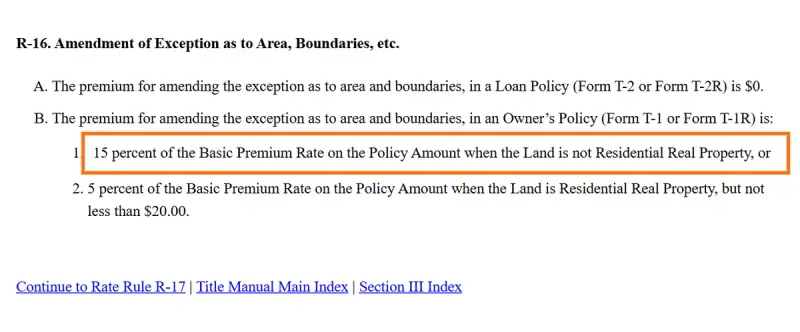
Every Texas owner's policy carries a standard exception for boundary conflicts, encroachments and other matters a survey would show. Amending it requires a survey the title company accepts and, on commercial land, costs 15 percent of the basic premium under Rule R-16. The T-19.1 endorsement costs 15 percent on its own, or 10 percent when you also buy the survey amendment. On the loan policy the survey amendment is $0.
Because both are percentages of the basic premium, they are worth a deliberate decision on any deal over a few million dollars. On most improved commercial property the coverage is worth far more than the premium, since a boundary or encroachment problem can cost more than the whole policy. On raw land with an old survey, the conversation is different.
What the premium does not include
Under Rate Rule R-1, the basic premium covers the title insurance, the title examination and closing the transaction, as those terms are defined in the Texas title manual. Several other costs appear on a commercial settlement statement, and none of them are set by the state:
- The escrow fee. Each title company sets its own. On a commercial deal it reflects the work involved: the number of parties, holdbacks, a 1031 exchange, multiple loans or a split closing.
- Tax certificates. The title company orders these from the taxing authorities to confirm what is owed on the property.
- Recording fees. The Dallas County Clerk charges by the document and by the page to record the deed, the deed of trust and any releases or assignments.
- The survey. A commercial survey is ordered from a surveyor, usually by the buyer, and its cost depends on the site and on the lender's requirements.
- Delivery and wire charges. Small, but they are on the statement.
Because these are the only title-related costs that differ between companies, they are the only ones worth comparing. Ask for them in writing for your price, loan amount and county. We do not publish a fee schedule in this article, because the right figure depends on the transaction. Ask our office and we will send one for your deal.
One thing never to compare is the premium itself. An offer to discount it, rebate part of it or "match" it is not a better price. Texas Insurance Code Section 2502.051 prohibits rebates and discounts on title insurance, and an offer like that tells you something about the company making it.
Who pays for title insurance on a Dallas commercial deal
It is negotiated. Texas has no required commercial contract form, so the purchase agreement decides who pays for the owner's policy, the survey, the survey amendment and the endorsements. Many Texas commercial contracts put the basic owner's premium on the seller and the survey amendment, endorsements and the lender's policy on the buyer, but that is a custom, not a rule, and it is traded like any other term.
What matters is that the contract says so in specific terms. "Seller pays for the title policy" leaves the 15 percent survey amendment and the T-19.1 open to argument, and on a $20 million deal those two lines come to more than $16,000. Name each item:
- the basic owner's policy premium;
- the survey and who orders it;
- the amendment of the area and boundaries exception;
- owner's endorsements, named by form number where you can;
- the lender's policy and its endorsements;
- the escrow fee and how it is split.
If you are the seller, our checklist on what the seller owes the title company on a Texas commercial sale shows where these costs land on your side of the statement.
How to get the exact figure before you sign
You can get within a few dollars of the final title premium on the day you sign the letter of intent. The steps:
- Run the basic premium. Enter the purchase price in the premium calculator. That is the owner's policy.
- Add the loan policy. $100 if the loan is no larger than the price. If the loan is larger, run the loan amount too and apply the R-5 arithmetic above.
- Decide on survey coverage. If you want the area and boundaries exception amended, add 15 percent of the basic premium and confirm that a survey acceptable to the title company exists or is on order.
- List the endorsements. Send the lender's closing instructions or endorsement checklist to the title company early. The percentage endorsements can be priced immediately, and the flat ones are $100 or less each in most cases.
- Ask for the non-premium fees in writing. Escrow fee, tax certificates, recording estimate and delivery.
The number becomes final when the title commitment and the settlement statement are issued. If the price or the loan amount changes during due diligence, the premium changes with it, by the same formula. Reading the commitment is the other half of the job: the premium buys the coverage described there, minus the exceptions on Schedule B. Our guide to reading a Texas commercial title commitment shows what to look for.
What you get for the premium when we handle the file
Since the premium is the same everywhere in Texas, the difference between title companies is the work behind it. Aurum Title Inc. is a Texas title agent (TDI license 2752531) in Dallas, at 8150 N Central Expy, Suite 1100. We are attorney-owned: three of our four owners are Texas attorneys, and our executive escrow officer, Austin Pennington, is Board Certified in Civil Trial Law. Our licensed escrow officers are Austin Pennington, Kay Alton Farr and Monday Locklear, and policies are underwritten by Chicago Title, Fidelity National Title and Westcor.
On a commercial file that means the liens, easements, entity documents and survey questions in the commitment get attorney attention early, on a systemized process, instead of at the closing table. Our commercial title insurance and escrow page describes the deals we handle.
If you have a Dallas building or apartment community under contract or in a letter of intent, you can open a title order or ask our office for a full closing estimate. Send the price, the loan amount and the property address, and an escrow officer will confirm the premiums and the fees for that deal.
Frequently asked questions
How much is title insurance on a $5 million commercial property in Texas?
The basic owner's policy premium on $5 million is $21,466 under the Texas rates effective March 1, 2026. A lender's policy issued at the same closing adds $100 if the loan is no larger than the price. The survey amendment and endorsements are extra and are also set by the state.
How much is title insurance on a $20 million apartment complex in Dallas?
The basic owner's premium on a $20 million policy is $66,866. With a simultaneous loan policy, the commercial survey amendment and the T-19.1 endorsement, the four items total $83,682.50. Lender endorsements, the escrow fee and recording costs come on top of that.
Is commercial title insurance more expensive than residential in Texas?
The basic premium chart is the same for both. What differs is the survey amendment, which is 15 percent of the basic premium on commercial land against 5 percent on residential property, and the T-19.1 endorsement, which also carries a higher percentage on commercial land.
Can I negotiate the title insurance premium on a large commercial deal?
No. Texas premiums are promulgated, and the Insurance Code prohibits discounts and rebates at any deal size. You can negotiate who pays the premium in the purchase contract, and you can compare the escrow fee and other charges each company sets.
Is commercial title insurance paid every year?
No. The premium is paid once, at closing. The owner's policy stays in force for as long as you or your heirs own the property, and the loan policy lasts until the insured loan is paid off.
Does a refinance of a Dallas commercial building cost the full premium again?
Not usually. A refinance needs only a new loan policy, and Rate Rule R-8 gives a credit of 50 percent or 25 percent of the premium on the payoff balance when the loan being paid off was insured within the last four or eight years. The existing owner's policy stays in place.
Who usually pays for the owner's title policy in a Texas commercial sale?
The contract decides. Sellers often pay the basic owner's premium and buyers often pay for the survey amendment, endorsements and the lender's policy, but every item is negotiable. Name each one in the purchase agreement so nothing is left to custom.