Short answer
In Texas, title insurance on a commercial deal can be issued only by a title insurance company or by a title agent licensed by the Texas Department of Insurance and appointed by an underwriter. The premium is set by TDI and is the same at every company, so what differs is how soon the commitment issues and clears. That depends mostly on what the title company receives on day one: the signed contract, the prior policy and survey, entity documents and payoff details.
This guide answers
- Who can issue title insurance for a commercial deal in Texas quickly?
Key takeaways
- Only a TDI-licensed title agent or a title insurance company can issue a Texas title policy (Tex. Ins. Code §2651.001); you can check any agent's license on TDI's lookup.
- The premium is promulgated, so compare title companies on process, people and communication, not on the premium.
- A commitment issues sooner when the order arrives with the contract, prior owner's policy, prior survey, entity names and existing loan details.
- It clears sooner when Schedule C items that depend on third parties, such as lien releases, payoffs and entity approvals, are started in the first days.
- The survey, entity documents, unreleased liens, unusual coverage requests and probate or heirship chains are the usual reasons a commitment sits open.
Any licensed Texas title agent can issue it; speed comes from the file, not the premium
Title insurance on a Texas commercial property can be issued by a title insurance company directly or by a title agent that holds a TDI license and an appointment from that company. Texas Insurance Code §2651.001 bars anyone from acting as a title insurance agent in Texas without a license issued by the department and the required bond or deposit. Aurum Title Inc. is a Texas title agent, TDI license 2752531, and our policies are underwritten by Chicago Title, Fidelity National Title and Westcor.
Because Texas title premiums are promulgated by TDI (Tex. Ins. Code §2703.151), the premium for the same commercial policy is the same at every title company. The question a buyer, lender or broker is really asking is how soon a commitment can be issued and how soon its requirements can be cleared. No title company can honestly put a number on that before it has seen the file, because the answer depends on the public records, the survey and the people outside the title company who must sign something.
What is predictable is the list of things that make a commitment come out sooner and the list of things that hold it open. This guide covers both, so you can send the order in a way that keeps the title work off the critical path of your deal. For how to read the commitment once you have it, see how to read a Texas commercial title commitment.
What happens between the order and the commitment
Every commercial commitment goes through the same stages. Knowing them shows where an order can stall.
- Order opened. The title company receives the contract or a request from the buyer, lender or broker and opens a file. Missing basics (the legal description, the seller entity, the buyer entity, the policy types) are requested here.
- Search. The records are searched for the chain of title, open liens, judgments, recorded easements, plats, restrictions and other matters. A prior owner's policy lets the examiner start from a known point instead of rebuilding the full chain.
- Examination. An examiner reads the search, decides what must be listed as an exception in Schedule B and what must be resolved before closing in Schedule C.
- Commitment issued. The commitment (TDI Form T-7) goes to the parties with copies of the recorded documents behind each exception, so the buyer, lender and surveyor can review them.
- Requirements cleared. Payoffs, releases, entity documents, tax certificates and affidavits are collected and checked. The commitment is updated if the survey or new filings change it, and the policy issues after closing.
Stages 1 to 4 decide when you get a commitment. Stage 5 decides when you can close on it. Most delays people blame on the title company happen in stage 5 and come from documents that only a seller, a lender or an outside party can provide.
The seven inputs that let a commitment issue sooner
The single largest factor in how soon a commitment issues is how complete the order is. A file that arrives with these seven items rarely waits for the title company to chase the basics.
Commercial title order packet: what to send and why it matters
| What to send | Why it speeds the commitment | Who usually has it |
|---|---|---|
| Fully signed contract with every amendment and any assignment | Sets the parties, the price, the title and survey deadlines and who pays for which policy | Buyer's broker or attorney |
| Seller's prior owner's policy | Gives the examiner a starting point and a prior list of exceptions to compare | Seller or seller's broker |
| Existing survey, and the name of the surveyor if a new one is ordered | Lets the examiner check the legal description and plan the survey review | Seller; buyer for a new survey |
| Exact legal names of the seller and buyer entities, and who will sign | Starts the entity and authority review on day one instead of the week before closing | Each side's attorney |
| Existing loans on the property with lender contacts | Payoff letters can be ordered as soon as the file opens | Seller |
| Lender, loan amount and lender's title requirements | Lets the loan policy, endorsements and any underwriter approvals be set up early | Buyer or loan broker |
| Contacts for brokers, attorneys and any 1031 exchange intermediary | Questions go straight to the person who can answer them | Buyer's broker |
How to read this table: the middle column is the reason each item matters, and the right column is who to ask for it. If any item in the left column is missing when you open the order, the title company will ask for it before the commitment can be complete, so the simplest habit is to collect them the day the contract is signed.
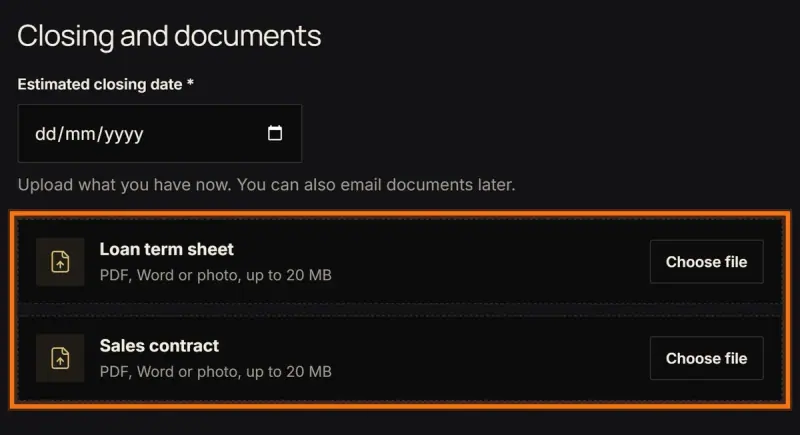
On Aurum's title order form, the second step asks for the estimated closing date and lets you upload the sales contract and the loan term sheet. Anything else on the list can be emailed to the escrow officer after the order is open.
What Schedule C asks for, and why it decides when you can close
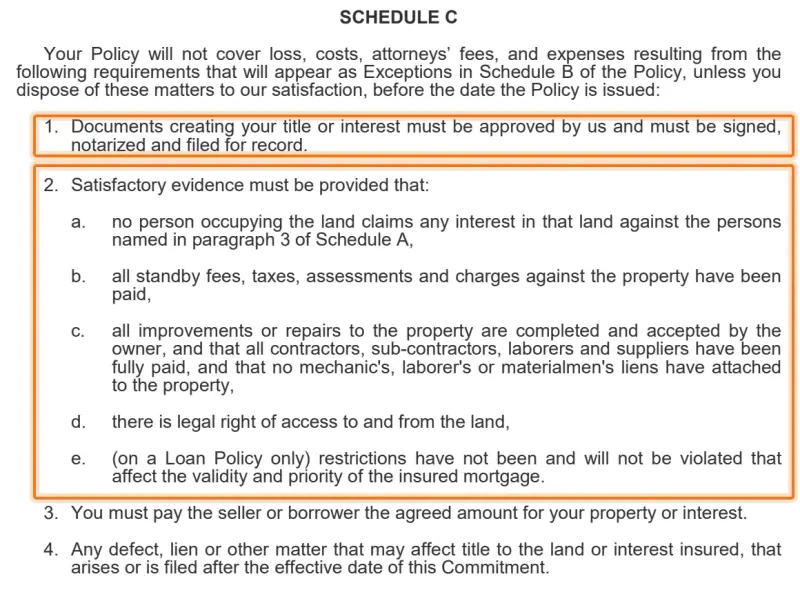
Schedule C of the commitment is the list of requirements that must be met before the policy issues. The T-7 is direct about the consequence: any requirement not disposed of to the title company's satisfaction becomes an exception in the policy. Lenders rarely fund with their requirements still open, so in practice Schedule C is the closing to-do list.
Four standard requirements appear on every Texas commitment: the documents creating your interest must be approved, signed, notarized and recorded; satisfactory evidence must be provided on occupants, taxes, completed and paid-for work, legal access and (for a loan policy) restrictions; the purchase price or loan proceeds must be paid; and anything filed after the effective date must be dealt with.
A commercial commitment then adds requirements that come from the search: releases of existing deeds of trust, releases of abstracts of judgment or tax liens, entity documents, tax certificates and any curative item. Each of these has an owner. The faster each owner gets the request, the faster the list closes. Entity and authority items have their own guide: entity and authority documents for a Texas commercial closing.
What usually holds a commercial commitment open
When a commitment sits open, the reason is almost always one of six things. None of them is unusual, and each one is easier when it is spotted early.
- The survey arrives late or does not match. The commitment's legal description, the survey and the vesting deed must agree. A new survey ordered after the commitment issues often brings new questions about easements, encroachments or access. Our guide to survey and boundary issues on commercial land covers the common ones.
- Entity documents are incomplete. The title company needs to know that each entity exists, is in good standing and that the person signing has authority. Missing operating agreement pages, a lapsed franchise tax status or a signer who is not the manager of record all hold the file.
- A lien has been paid but never released. Old deeds of trust, mechanic's liens and judgments that were satisfied years ago still show in the records until a release is recorded. Getting a release from a lender that has merged or closed takes time; our problem title and curative work page explains how those items are handled.
- The lender asks for coverage that needs underwriter approval. Some endorsements, and large or unusual risks, need the underwriter's sign-off before the agent can commit to them. Knowing the lender's requirements on day one lets that request start early.
- Taxes and assessments are not current. Tax certificates are ordered from each taxing unit. Delinquent taxes, rollback taxes on land leaving an agricultural appraisal, or special district assessments must be paid or handled at closing.
- The chain of title runs through an estate, a divorce or a foreclosure. Probate records, heirship affidavits or foreclosure documents must be reviewed and sometimes corrected. See liens, heirship and probate property.
Items 1 to 4 are mostly in the parties' control. Items 5 and 6 depend on the records and on third parties, which is why they should be raised as soon as the commitment shows them.
Order the survey early and tell the surveyor about the commitment
On most commercial deals the survey is the item that arrives last. The buyer usually orders it, the lender usually specifies its standard, and the title company needs it to remove or amend the survey-related exceptions in Schedule B.
- Order the survey when the contract is signed, not after the commitment issues.
- Send the surveyor the commitment and copies of every recorded easement and plat as soon as they are available, and ask that each one be shown on the drawing or noted as not affecting the land.
- If the seller has a recent survey, send it with the order. It may be enough to start the review even if the lender requires an update.
Under TDI Rate Rule R-16, the area and boundaries exception on an owner's policy for non-residential land can be amended to read only "shortages in area" when an acceptable survey is provided, for an additional premium of 15 percent of the basic rate. On a loan policy that amendment has no charge. Both depend on a survey the title company can accept, which is another reason to start it on day one. The full premium for your policy amount can be estimated with the Texas title premium calculator.
Get entity and authority documents in before they are asked for
On commercial deals both sides are usually entities, and the title company cannot insure a deed or a deed of trust until it knows who may sign. The most common Schedule C requests are:
- the certificate of formation and, for an LLC, the company agreement or the pages that name the managers and give signing authority;
- a certificate of account status or good standing showing the entity's franchise tax status;
- a resolution or consent approving the transaction and naming the signer, when the governing documents require one;
- for a newly formed buyer entity, the filed formation documents with its exact name, so the commitment and the loan documents match.
Sending these with the order, or as soon as the buyer entity is formed, turns a closing-week scramble into a routine check. If the buyer's name changes after an assignment, tell the title company at once: Schedule A and every document drafted from it depend on the final name.
Payoffs and releases: start them the day the file opens
Every existing lien on the property must be paid and released, or the buyer and lender must agree to take subject to it. Payoff letters come from the seller's lenders, and they are only good through a stated date, so they are often ordered twice: once to see the number, once for the closing date.
The quickest files are those where the seller lists every loan and lender contact with the order and signs the authorization the lender needs to talk to the title company. Older liens that show as open of record but were paid long ago need a release from the original lender or its successor. Those are worth identifying in the first commitment, because they can take longer than anything else on the list. Construction and mechanic's lien issues have their own steps: construction loans and mechanic's liens in Texas.
How Aurum Title handles a commercial commitment
Aurum Title is attorney-owned: the owners include the managing partners of Atwood & McCall, PLLC, and our executive escrow officer, Austin Pennington, is an attorney. Our licensed escrow officers are Austin Pennington, Kay Alton Farr and Monday Locklear. That matters most in stage 5, when a defect, lien or authority question needs a decision rather than another email.
The other half of how we work is a systemized process: the operation is organized so that each file moves through the same stages in the same order, with nothing left to memory. You get the most out of that by sending the order packet above with the order and by naming one person on your side who can answer entity, survey and payoff questions. When the commitment issues, read Schedule B and Schedule C the same day and send us anything you know that the records do not show.
If you have a commercial property under contract in Dallas County, you can open a title order and an escrow officer will confirm what we need to issue the commitment. Our commercial title and escrow page lists the deal types we handle, from multifamily and industrial to land and 1031 exchange closings, and how long a commercial closing takes in Dallas explains where title work fits in the overall calendar.
Frequently asked questions
Who can issue title insurance for a commercial deal in Texas quickly?
Any title insurance company, or any title agent licensed by TDI and appointed by an underwriter, can issue it. The premium is the same everywhere because TDI sets it. How soon the commitment issues and clears depends on how complete the order is and on third-party items such as payoffs, releases and the survey.
How do I check that a Texas title agent is licensed?
TDI publishes a license lookup for agents and companies on its website. Search by the company name or license number and look at the appointments to see which underwriters the agent writes for and in which counties. Aurum Title's license number is 2752531.
Can I get a commitment before the survey is done?
Yes. The commitment can issue from the search and the legal description in the records. The survey is then reviewed against it, and the survey-related exceptions in Schedule B are amended or kept depending on what the survey shows.
Does a faster commitment cost more?
No. Texas premiums are promulgated, and under Rate Rule R-12 the commitment itself carries no premium beyond the policy issued under it. Escrow fees and other charges are set by each title company and should be quoted to you itemized.
How long is a commitment valid?
The T-7 form ends the commitment ninety days after its effective date unless the policy issues sooner. If your due diligence or financing runs longer, ask for an updated commitment before closing.