Short answer
A Texas title company's escrow handles the real estate half of a combined sale: the title search, the deed, payoffs, prorations, the settlement statement and the owner's and loan title policies. The business assets (equipment, inventory, goodwill, licenses) transfer under an asset purchase agreement drafted by the parties' attorneys, and title insurance does not cover them. Both halves usually close on the same day, each conditioned on the other, and the escrow can hold and disburse the business funds too when the parties' written instructions say so.
This guide answers
- Who handles escrow for a business and real estate sale together in Dallas?
Key takeaways
- The title policy insures the land and building only. Under TDI Procedural Rule P-66 the owner's policy amount is the sales price of the land and existing improvements, so the contract's price allocation sets the policy amount and the promulgated premium.
- Most combined sales use two agreements, an asset purchase agreement and a real estate contract, each conditioned on the other and closed on the same day.
- Under Texas Tax Code Section 111.020 a buyer who does not withhold for the seller's unpaid state taxes can be liable for them up to the purchase price. The Comptroller's certificate of no tax due, requested on Form 86-114 before closing, is the protection.
- Equipment liens are not in the title commitment. A UCC search at the Texas Secretary of State and a check of county records for fixture filings and state tax lien notices cover what the land records search does not.
- SBA 7(a) loans can fund real estate, equipment and a change of ownership together, while 504 loans fund fixed assets, so the loan program shapes the closing documents.
- The title company is not either side's lawyer, does not draft the asset purchase agreement and does not give tax advice.
The title company's escrow closes the real estate, and the business closes beside it
When a Dallas owner sells an operating business together with its building or land, a Texas title company's escrow handles the real estate: the title search, the deed, lien payoffs, tax prorations, the settlement statement and the owner's and loan title policies. The business assets pass under an asset purchase agreement written by the parties' attorneys. Both closings normally happen on the same day, and neither funds unless the other does.
Owners of restaurants, car washes, daycares, auto shops, dental practices and small manufacturers think of the sale as one deal at one price. Legally it is two transfers that travel together:
- The real property (land, building, and whatever is permanently attached) transfers by a deed recorded in the county records and can be insured by a title policy.
- The business (equipment, inventory, the name, customer lists, contracts, goodwill, licenses) transfers by a bill of sale and assignments. None of it is recorded in the land records, and none of it is covered by title insurance.
Our commercial escrow page describes the escrow side of our work. This guide explains where the line falls, who is responsible for each piece, and what to bring on day one.
What the title company's escrow covers, and what it does not
On the real estate, the escrow officer's work is the same as on any Texas commercial title and escrow file:
- holding the earnest money under the real estate contract;
- searching title and issuing the commitment that lists what must be cleared;
- collecting payoff letters and releases for every lien on the land;
- prorating property taxes, and rent if part of the building is leased;
- preparing the settlement statement, receiving funds, recording and disbursing;
- issuing the owner's policy to the buyer and the loan policy to the lender.
What the title policy insures is narrower than what the buyer is paying for. TDI Procedural Rule P-66 says an owner's policy on a fee simple purchase is issued for the current sales price of the land and any existing improvements. Equipment, inventory, the trade name, goodwill and licenses sit outside that amount and outside the policy. A defect in the seller's ownership of a paint booth or a walk-in cooler is not a title claim.
The escrow can still play a part in the business side. As a matter of general practice, a Texas title company's escrow can receive and disburse the business portion of the price when the parties' written instructions say so and the title company agrees to them. Ask the escrow officer at the start whether that is the plan. The alternative is for the attorneys to close the asset sale while only the real estate money runs through the title company.
Three limits apply either way. The title company is not the buyer's lawyer or the seller's lawyer. It does not draft the asset purchase agreement, the bill of sale or a lease. And it does not give tax advice, including on how to divide the price.
One contract or two, and how the closings are tied together
Most combined sales in Dallas-Fort Worth are papered with two agreements. An asset purchase agreement covers the business. A commercial real estate contract covers the land and building and names the title company. Some deals use one agreement with a real estate exhibit. Which structure fits is a legal and tax decision for the parties and their advisers.
Two contracts mean two sets of deadlines, so the attorneys tie them together:
- Cross-conditions. Each contract says the buyer is not required to close one purchase unless the other closes at the same time. Without that sentence, a buyer could end up owning a restaurant with no building.
- Cross-defaults. A default under one agreement is a default under the other, and the contracts say what happens to each deposit.
- Matching dates. Feasibility, financing and closing dates line up. The business side often has the slower items, such as license transfers and the state tax certificate described below.
- Different sellers. Often the operating company owns the business and the owner's separate LLC owns the building: two sellers and two sets of authority documents.
At the table there is usually one closing with two sets of documents. The money can be shown on a single settlement statement with the business assets as a separate line, or on a title company statement for the real estate plus a closing statement for the business from the attorneys. The lender's instructions often decide which.
When a lender, two sellers and several brokers each send instructions, the escrow officer merges them into one funding plan. Our guide to commercial escrow with multiple parties covers how conflicts are resolved and how the Texas good funds rule controls when money leaves the account.
How the price allocation sets the policy amount and the premium
The contract divides the price among the real property, the equipment and other tangible assets, and goodwill. That allocation drives the tax result for both sides, and it also decides the title numbers.
Because P-66 ties the owner's policy to the sales price of the land and improvements, the amount allocated to real property is normally the owner's policy amount. The premium comes from the rate chart the Texas Department of Insurance promulgates, so it is the same at every Texas title company. Above $100,000 the chart works in brackets: from $1,000,001 to $5,000,000, the basic premium is $5,226 plus $4.06 for each $1,000 over $1,000,000.
A worked example. A car wash sells for $2,400,000, and the contract allocates $1,500,000 to the land and building and $900,000 to equipment, inventory and goodwill. The owner's policy is written for $1,500,000, and the basic premium is $5,226 plus $2,030, or $7,256. Run your own figure with the Texas title premium calculator.
The allocation has to be the real one. It is negotiated by the parties with their CPAs and reported to the IRS: per the IRS page for Form 8594, both the seller and the buyer of a group of assets that makes up a trade or business use that form when goodwill or going concern value attaches. A real property figure set low to trim the premium leaves the buyer underinsured on the one asset title insurance protects.
The loan policy needs a second look. Under Rate Rule R-5, a loan policy issued with the owner's policy costs $100 when, among other conditions, its amount does not exceed the owner's policy. A loan that also finances the business can be larger than the real estate allocation. If the lender asks for a loan policy above the owner's policy amount, R-5 prices it at the basic rate for the loan amount, minus the basic rate for the owner's policy, plus $100. In the example, a $2,000,000 loan policy would cost $9,286 minus $7,256 plus $100, or $2,130. The lender decides the amount it wants insured, so ask early.
Our self-storage guide draws the same line between real property, personal property and the business.
Searches beyond the land records: UCC filings, fixture filings and state tax liens
A title commitment reports what is recorded against the land. Liens on the seller's equipment are filed in other places.
UCC financing statements
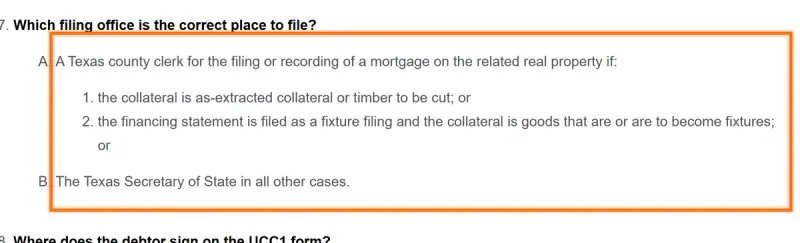
A lender with a security interest in the seller's equipment or inventory gives public notice by filing a financing statement. Under Texas Business and Commerce Code Section 9.501, the filing office is the Secretary of State, with one exception that matters here: a financing statement filed as a fixture filing goes to the office where a mortgage on the related real property would be recorded, which is the county clerk. The Secretary of State's UCC questions and answers say the same thing.
Fixtures are where the two halves of the deal overlap. A vehicle lift, a car wash tunnel or a commercial hood may be financed by an equipment lender whose fixture filing sits in the Dallas County real property records. That filing can appear in the title search. A filing made only with the Secretary of State will not.
State tax liens
Under Texas Tax Code Section 113.001, taxes owed to the state are secured by a lien on all of the taxpayer's property. Section 113.101 protects a bona fide purchaser or lender who acquires an interest before the lien is filed, which for real property means filed in the county where the property is located. A state tax lien notice against the seller is therefore something the county records search should catch, and it must be paid and released at closing.
What to do with the results
Search under the seller's exact legal name and any prior names. Every financing statement that covers assets being sold needs a payoff and a termination, or the buyer's written agreement to take the asset subject to it. Who orders the UCC search varies: the buyer's attorney, the lender or the title company at a party's request. Decide it in the first week.
The seller's Texas taxes can follow the business to the buyer
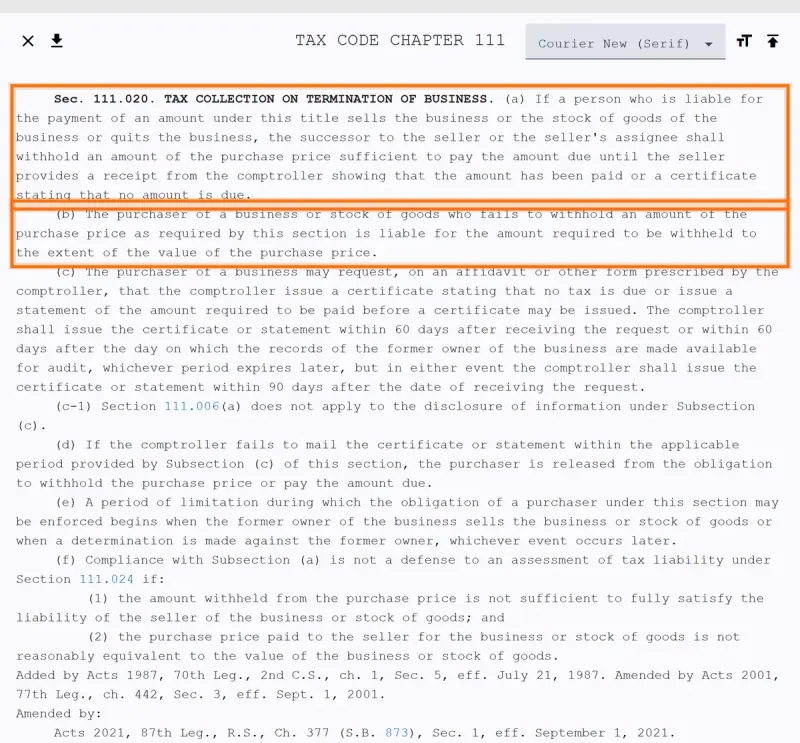
Texas Tax Code Section 111.020 says that when a person who owes an amount under the state tax title sells the business or its stock of goods, the buyer must withhold enough of the purchase price to pay the amount due until the seller provides a Comptroller receipt showing payment or a certificate stating that no amount is due. A buyer who fails to withhold is liable for that amount, to the extent of the value of the purchase price. Sales tax is the usual exposure for a restaurant, a shop or a car wash.
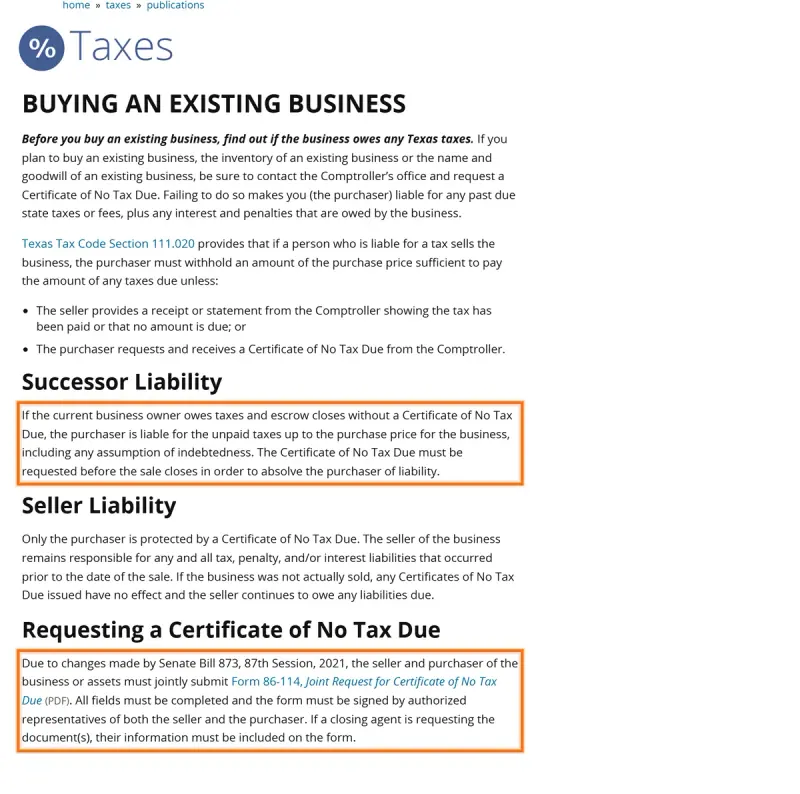
The same section lets the buyer ask the Comptroller for a certificate that no tax is due, or for a statement of the amount that must be paid first. The Comptroller's publication Buying an Existing Business gives the practical details:
- The seller and buyer jointly submit Form 86-114, Joint Request for Certificate of No Tax Due, signed by authorized representatives of both. If a closing agent requests the documents, the agent's information goes on the form.
- The certificate must be requested before the sale closes to protect the buyer.
- There is no charge. The Comptroller says a certificate or a statement of account is usually issued within 10 business days of a proper request, and that it can take up to 90 days if an audit of the seller's records is needed.
- Certificates are specific to each tax, and the form also asks about the seller's franchise tax responsibility.
- Only the buyer is protected. The seller still owes its own taxes.
The statute sets an outer limit: the Comptroller must issue the certificate or statement within 90 days of the request, and if it does not, the buyer is released from the obligation to withhold.
At closing, one of three things happens: the certificate has arrived, the date moves, or the buyer withholds part of the business price under terms the attorneys write. Send the request as soon as the contracts are signed.
SBA 7(a) and 504 loans that fund both pieces
Many owner-occupied purchases in North Texas are financed with a loan backed by the U.S. Small Business Administration, and the program determines what the loan can pay for.
- 7(a). SBA's program page (sba.gov) lists the permitted uses, which include acquiring real estate and buildings, purchasing machinery, equipment, furniture and fixtures, working capital, and changes of ownership, alone or combined in one loan. SBA states a maximum 7(a) loan amount of $5 million. One 7(a) loan can therefore fund both the building and the business.
- 504. SBA describes 504 loans as long-term, fixed rate financing for major fixed assets, available through Certified Development Companies working with a senior lender. Permitted uses include buying existing buildings or land and long-term machinery and equipment. SBA says a 504 loan cannot be used for working capital or inventory, so goodwill and inventory in a combined purchase need another source of funds.
For the title company, an SBA loan shows up in the lender's closing instructions. SBA's 504 Debenture Closing Checklist (SBA Form 2286) lists title insurance and a UCC search as the evidence of lien priority on real and personal property collateral, along with the lien instrument on the project property and a security agreement with UCC filings. A 504 project has a senior lender and a development company, so the recording order and each loan policy's exceptions come from their instructions.
The specific title requirements, endorsements and policy amounts come from each lender's instructions and SBA's loan program requirements, not from the title company.
Authority, leases, holdbacks and federal tax forms
Who can sign
A combined sale often has two selling entities and one or two newly formed buying entities. The title company needs formation documents, the company agreement or bylaws, and a consent naming the signer for each entity that signs a deed or a deed of trust. Our guide to entity authority documents for a Texas commercial closing lists what each entity type provides.
When the seller keeps the building, or stays in it
If the seller keeps the real estate and leases it to the buyer, there is no owner's policy on the fee, and the buyer's protection is the lease its attorney negotiates. P-66 does provide for an owner's policy on a leasehold estate, which some buyers and lenders ask for on a long lease. If the seller sells the building and stays as a tenant, the leaseback is signed at closing. Either way, the attorneys draft the lease.
Holdbacks and post-closing escrows
Business sales produce holdbacks that plain real estate sales do not: an amount for the tax certificate, an inventory count trued up after closing, a permit that issues later, or an indemnity reserve. Each needs a written escrow agreement stating the amount, the release event, the evidence required, a deadline and what happens in a dispute. Who holds a particular holdback is agreed case by case.
FIRPTA and Form 1099-S
Two federal items attach to the real estate. If the seller of the real property is a foreign person, the IRS says the buyer generally must withhold 15% of the amount realized under FIRPTA; a seller that is not foreign signs a certification instead. And under the IRS instructions for Form 1099-S, the person responsible for closing a real estate transaction generally files that form, with exceptions that include a seller that is a corporation. How the business assets are reported is a question for each side's CPA. The seller's side of these items is covered in what a commercial seller owes the title company.
Who does what on a combined business and real estate closing
Responsibilities by party on a Dallas business sale that includes the real estate
The usual division of work. Your contracts and lender's instructions control.
| Task | Title company | Buyer's attorney | Seller's attorney | Lender | CPA |
|---|---|---|---|---|---|
| Real estate contract, earnest money | Holds the deposit | Negotiates | Negotiates | Gets a copy | No role |
| Asset purchase agreement, bill of sale, lease | Does not draft | Drafts or reviews | Drafts or reviews | Approves loan-related terms | Advises on tax terms |
| Title search and commitment | Performs and issues | Reviews, objects | Clears seller items | Approves exceptions | No role |
| Price allocation | Uses the real property figure for the policy | Documents it | Documents it | Reviews it | Advises; Form 8594 |
| UCC and tax lien searches | County records; UCC search if requested | Orders or reviews | Arranges terminations | Requires them | No role |
| Certificate of no tax due | Shows any agreed withholding | Requests with seller | Signs, supplies records | May require it | Confirms returns are filed |
| Loan documents and instructions | Follows, records, issues loan policy | Reviews for borrower | No role | Prepares | No role |
| Settlement statement, disbursement | Prepares; disburses its escrow | Approves | Approves | Approves and funds | Reviews tax items |
| Licenses, permits, employees | No role | Handles for buyer | Handles for seller | May condition funding | Payroll and tax accounts |
How to read this table: the title company column is full only in the rows that touch the land, the recorded documents and the money in its escrow. Every row where it says "does not draft" or "no role" needs a named person on your side before the contracts are signed.
A day-one document checklist
Send these when you open the title order, or as soon as each one exists, so the title company knows from the first day that a business is part of the sale.
- Both agreements: the signed real estate contract and the asset purchase agreement (or its term sheet), with the price allocation.
- The parties: exact legal names of each selling and buying entity, and which one owns or will own the real estate.
- Entity documents for each: formation documents, company agreement or bylaws, and the consent naming the signer.
- The seller's prior owner's policy and survey, if it has them.
- Lien information: every lender on the building and on the equipment, with loan numbers, for payoffs and UCC terminations.
- The buyer's lender: the loan program (conventional, SBA 7(a) or SBA 504), lender's counsel and, on a 504 loan, the development company.
- Leases: existing tenant leases, and the draft lease or leaseback if the seller keeps the building or stays in it.
- The tax certificate: the date Form 86-114 was sent to the Comptroller.
- The seller's tax status: foreign or not, and the tax identification details for Form 1099-S.
- Holdbacks: any amounts to be held after closing and the draft escrow terms.
- Contacts: both attorneys, both CPAs and the brokers, with phone numbers for confirming wire instructions.
If the seller plans to roll the building proceeds into replacement property, say so at the start, because the intermediary must be in place before closing. See 1031 exchange closings in Texas.
Aurum Title Inc. is a Texas title agent (TDI license 2752531) at 8150 N Central Expy, Suite 1100, in Dallas, handling title insurance and escrow for commercial real estate with policies underwritten by Chicago Title, Fidelity National Title and Westcor. We are attorney-owned: our executive escrow officer, Austin Pennington, is a Texas attorney, and our owners include a tax attorney and a corporate attorney who are managing partners of Atwood & McCall, PLLC. On a combined sale our role is the real estate closing, run on a systemized process alongside the attorneys who handle the business.
Frequently asked questions
Who handles escrow for a business and real estate sale together in Dallas?
A Texas title company handles the escrow and title insurance for the real estate. The business assets transfer under an asset purchase agreement prepared by the buyer's and seller's attorneys, and the two closings are scheduled for the same day with each conditioned on the other. Whether the business funds also pass through the title company's escrow depends on the parties' written instructions.
Does title insurance cover the equipment, inventory or goodwill I am buying?
No. A Texas owner's policy insures title to the land and its improvements, and the policy amount is based on the price of that real property. Equipment, inventory, the business name, licenses and goodwill are protected only by the seller's promises in the asset purchase agreement and by the lien searches your attorney orders.
Do I need two contracts to buy a business and its building?
Most deals use two, one for the business assets and one for the real estate, because the sellers are often different entities and the title company needs a real estate contract to work from. Some use a single agreement. Your attorney chooses the structure and makes sure neither purchase can close without the other.
How much is the title premium when part of the price is for the business?
The premium is calculated on the owner's policy amount, which follows the part of the price allocated to the land and building, using the rate chart the Texas Department of Insurance sets for every title company. If $1,500,000 of a $2,400,000 price is real property, the basic premium is $7,256. The allocation must reflect the actual deal and is reported to the IRS.
What is a Texas certificate of no tax due and when do I ask for it?
It is a Comptroller certificate confirming the seller owes nothing for a given state tax. Without it, a buyer who did not withhold from the price can be liable for the seller's unpaid taxes up to the purchase price. Seller and buyer request it together on Form 86-114, and the request has to be made before the sale closes.
Will the title commitment show liens on the seller's equipment?
Usually not. Most equipment liens are financing statements filed with the Texas Secretary of State, which is a separate search by the seller's legal name. The exception is a fixture filing recorded with the county clerk, which can appear in the real property records.
Can one SBA loan pay for both the business and the building?
An SBA 7(a) loan can, since SBA lists real estate, equipment and changes of ownership among its permitted uses. A 504 loan is limited to fixed assets such as land, buildings and long-term equipment and cannot fund working capital or inventory, so buyers using it need other money for those parts.