Short answer
A reverse 1031 exchange on Dallas property closes with three parties doing three jobs. An exchange accommodation titleholder, set up by your exchange company, takes title to the replacement property (or to the property you are selling) under IRS Revenue Procedure 2000-37. A Texas title company insures and records that title and closes both ends. Your tax adviser confirms the structure. From the day the titleholder takes title you have 5 business days to sign the exchange agreement, 45 days to identify what you will sell and 180 days to finish.
This guide answers
- Who handles a reverse 1031 exchange closing on Dallas commercial property?
Key takeaways
- In a reverse exchange you acquire the replacement property before you sell, so a third party, the exchange accommodation titleholder, holds title to one property in the meantime.
- The IRS safe harbor in Rev. Proc. 2000-37 sets three limits counted from the day the titleholder takes title: 5 business days, 45 days and 180 days.
- The titleholder, not you, is the buyer on the deed and the insured on the owner's policy during the parking period, so the lender has to approve the structure early.
- The title company closes and insures the transactions. It does not act as your titleholder or give tax advice.
- Tell the title company the deal is a reverse exchange when you open the order, not the week of closing.
Who handles a reverse 1031 closing, in plain terms
You found the replacement property in Dallas before your current property sold, and the seller will not wait. A reverse 1031 exchange lets you close on the new property now and still defer gain, as long as the old one sells in time. It is a real, IRS-recognized structure, and it closes at a title company like any other purchase. The difference is who takes title.
You cannot own both properties at once and call it an exchange. So a third party, the exchange accommodation titleholder, takes title to one of them and holds it until the other side closes. Three parties make that work:
- The exchange company. It supplies the titleholder, usually a special-purpose entity, and normally also acts as the qualified intermediary for the sale leg.
- The title company. It searches title, issues the commitment, closes the purchase into the titleholder's name, records the documents in the county deed records, issues the policies, and later closes the sale of the property you are giving up and the transfer back to you.
- Your tax adviser. A CPA or tax attorney decides whether the structure fits your facts. That is not the title company's call.
We close 1031 exchange transactions as part of our commercial escrow and 1031 exchange closings in Dallas. This guide explains the reverse version: the rules, the order of events, and what to settle before closing day. If your exchange runs in the normal order, sale first, start with our guide to 1031 exchange closings in Texas.
The IRS safe harbor and its three deadlines
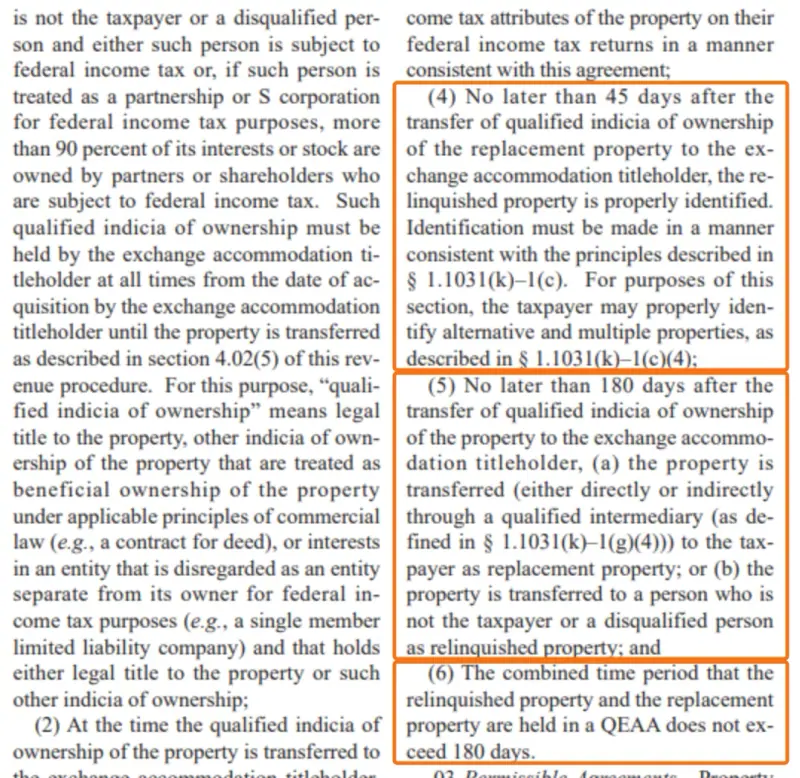
The ordinary 1031 rules were written for a sale followed by a purchase. The regulations for deferred exchanges do not cover the reverse order. In 2000 the IRS filled that gap with Revenue Procedure 2000-37, a safe harbor: if the property is held in a "qualified exchange accommodation arrangement," the IRS will treat the titleholder as the owner for federal income tax purposes, and the property can qualify as replacement or relinquished property in an exchange.
To be inside the safe harbor, the arrangement has to meet every requirement in section 4.02 of the procedure. The ones that drive the closing calendar are below.
Reverse exchange deadlines under Rev. Proc. 2000-37
| Deadline | What must happen | Counted from |
|---|---|---|
| 5 business days | You and the titleholder sign the written qualified exchange accommodation agreement | The day the titleholder takes title |
| 45 days | You identify the property you will sell (the relinquished property), in writing | The day the titleholder takes title to the replacement property |
| 180 days | The parked property is transferred: to you as replacement property, or to the outside buyer as relinquished property | The day the titleholder takes title |
| 180 days, combined | The total time the relinquished and replacement properties are held in the arrangement | All parking periods together |
How to read this table: every clock starts at the first closing, the day the deed to the titleholder is delivered. Nothing extends them inside the safe harbor. If the property you are selling has not closed by day 180, the procedure says it simply does not apply, and the tax result is decided on general ownership principles instead. Plan the sale before you close the purchase, not after.
Two more points from the IRS materials are worth knowing before you commit:
- You must mean it from the start. At the time the titleholder takes title, it has to be your real intent that the property will be part of a 1031 exchange.
- You cannot park property you already own. Revenue Procedure 2004-51 removed from the safe harbor any replacement property the taxpayer owned within the 180 days before the titleholder received it.
The IRS also says plainly that parking arrangements can be done outside the safe harbor, with no assurance either way. That is a conversation for your tax adviser. The IRS like-kind exchange page covers the general rules, including the limit to real property and the reporting on Form 8824.
Two ways to structure it: which property gets parked
Revenue Procedure 2000-37 describes two patterns. Which one you use changes who is on the deed at the first closing, so the title company needs to know before it prepares the commitment.
Exchange last: the titleholder parks the replacement property
The titleholder buys the Dallas replacement property from the seller and holds it. You then sell your relinquished property through a qualified intermediary in the usual way, and the titleholder transfers the replacement property to you to complete the exchange. This is the pattern most people mean by "reverse exchange." The titleholder is the buyer of record at closing number one.
Exchange first: the titleholder parks the property you are selling
Here the titleholder acquires the replacement property and immediately exchanges it with you for your relinquished property. You own the new property from day one, and the titleholder holds the old one until a buyer is found. The titleholder is in the chain of title for the old property instead.
The choice is usually driven by the lender. A lender on the new property generally wants its borrower to own the collateral, which favors exchange first. But exchange first requires you to transfer the old property to the titleholder at a set value before you know the final sale price, and any existing loan on the old property has to allow that transfer. Neither pattern is simpler in every case. Ask your exchange company which it recommends and why, then tell the escrow officer.
What changes at the closing table in Texas
For the seller of the replacement property, a reverse exchange closing looks ordinary: a deed is signed, money is wired, the sale funds. The differences are on the buyer's side.
- The grantee is the titleholder. The deed runs from the seller to the titleholder's entity, not to you. The contract is assigned to that entity before closing, so check that your purchase contract permits assignment.
- The insured is the titleholder. The owner's policy issued at that closing names the party that takes title. Ask at the start how coverage will follow the property to you when the parking period ends, and get the answer in writing with the premium, if any, for that step.
- Entity documents come from the exchange company. The title company needs the titleholder entity's formation and authority documents, the same way it does for any buying entity. Our guide to entity documents for a Texas commercial closing lists what is reviewed.
- There is a second conveyance. When your sale closes, the parked property moves from the titleholder to you. The safe harbor counts legal title, and also interests in a single member limited liability company that holds title, as ownership the titleholder can hold. Whether the property comes back to you by deed or another way is decided by your exchange company and tax adviser. Tell the title company which, because it affects the documents and the policy.
- Recording happens in the county where the land is. For Dallas property that is the Dallas County Clerk. Each recorded document carries its own recording fee.
Texas has no state transfer tax on deeds, which removes a cost that makes parking arrangements expensive in some other states. Recording fees, the exchange company's fee and any additional title charges still apply. Ask for all of them in the first estimate so the cost of the structure is clear before you commit to it.
Financing: get the lender's answer first
Most reverse exchanges that fail to launch stop at the lender, not at the IRS. In an exchange-last structure, the entity that owns the collateral for the first several months is a company controlled by your exchange firm. Many lenders will not make a loan on those terms without changes to their documents, and some will not make it at all.
The safe harbor leaves room to solve this. Section 4.03 of the procedure lists arrangements that do not disqualify the structure, even when they are not on arm's-length terms. Among them:
- you may guarantee the titleholder's loan or indemnify the titleholder against costs;
- you may lend or advance the purchase money to the titleholder yourself;
- the titleholder may lease the property to you during the parking period;
- you may manage the property and supervise improvements to it.
In practice that means the purchase can be funded by your own cash loaned to the titleholder, by a bank loan to the titleholder that you guarantee, or by a mix. Each version puts different documents in front of the title company: a deed of trust signed by the titleholder, a guaranty signed by you, sometimes a lease. The lender's closing instructions will also say whose name must appear on the loan policy and which endorsements it needs.
The order that works: get the lender's written approval of the structure before the contract's financing deadline, then send the lender's instructions and the exchange documents to the title company together. If the financing is private or short-term, our article on private, bridge and seller-financed loans explains what the title company needs from that kind of lender.
The closing sequence, step by step
For the common exchange-last structure on a Dallas commercial property, the order of events looks like this.
- Before the contract's deadlines run: hire the exchange company, confirm with your tax adviser that a reverse exchange fits, and get the lender's approval of the titleholder as owner.
- Open title. Open the title order on the replacement property and say that it is a reverse exchange. Give the escrow officer the exchange company's contact and the name of the titleholder entity as soon as it exists.
- Assign the contract. You assign your rights under the purchase contract to the titleholder. The seller is notified in writing.
- Close the purchase. The seller deeds the property to the titleholder. Loan documents, if any, are signed by the titleholder and by you as guarantor. The title company funds, records and issues the policies.
- Within 5 business days: the qualified exchange accommodation agreement between you and the titleholder must be signed. Most exchange companies have it signed at or before closing.
- Within 45 days: identify in writing the property or properties you will sell.
- Sell the relinquished property. This closes as a normal forward exchange leg through the qualified intermediary, at whichever title company the contract names. The proceeds go to the intermediary, not to you.
- Within 180 days of step 4: the intermediary uses the proceeds to acquire the replacement property from the titleholder, the titleholder's loan from you is repaid or the bank loan is assumed or replaced as the lender agreed, and the property is transferred to you. The title company handles the documents and any recording.
Steps 7 and 8 are where timing gets tight. A buyer's financing delay or a title problem on the property you are selling can use up weeks you do not have. Clear the title on the relinquished property early: order that commitment as soon as you list it, not when a contract arrives. Our guide to how long a commercial closing takes in Dallas shows which items hold a closing up.
Common ways a reverse exchange goes wrong
None of these are exotic. Each one comes from treating the first closing as a normal purchase.
- You take title yourself. If the deed at the first closing names you or your own entity as grantee, there is nothing left to exchange into. The grantee must be the titleholder.
- The agreement is signed late. The five-business-day limit is short, and it runs from the transfer of title, not from funding or recording.
- The contract cannot be assigned. A purchase contract that prohibits assignment needs an amendment before closing.
- The lender finds out at closing. A borrower name that does not match the loan approval stops the funding.
- The sale takes longer than 180 days. There is no extension inside the safe harbor for a slow market or a buyer who walks.
- The property was already yours. Property you owned within the prior 180 days cannot be parked under the safe harbor.
- Sale proceeds touch your account. The sale leg is still a 1031 exchange. If you receive the money, the exchange is broken, as our 1031 closing guide explains.
A short call between the exchange company, the lender, the escrow officer and your tax adviser before the purchase contract's option or feasibility period ends prevents most of this list.
What to send the title company on day one
The more of this the escrow officer has at the start, the fewer surprises there are in the last week:
- the purchase contract and all amendments, including any assignment language;
- the exchange company's name, contact and the titleholder entity's exact legal name;
- which structure you are using: exchange last or exchange first;
- the lender's contact and, when issued, its closing instructions and endorsement list;
- the survey, or the date a new one is due;
- the address and status of the property you plan to sell, and whether you want that title opened now;
- how the property will be transferred to you at the end of the parking period, once your advisers have decided.
With that in hand, the commitment can be issued in the titleholder's name, the requirements on Schedule C can be worked while you market the other property, and the settlement statements for both closings can be drafted to match the exchange documents.
How we handle exchange closings at Aurum Title
Aurum Title Inc. is a Texas title agent (TDI license 2752531) at 8150 N Central Expy, Suite 1100, in Dallas. We provide title insurance and escrow for commercial and residential real estate, including commercial escrow and 1031 exchange closings. We are attorney-owned: three of our four owners are Texas attorneys, and our executive escrow officer, Austin Pennington, is an attorney who is Board Certified in Civil Trial Law. Our licensed escrow officers are Austin Pennington, Kay Alton Farr and Monday Locklear.
What that means on a reverse exchange: the entity documents, the assignment, the loan structure and the transfer back to you are read by people who handle complex title and closing questions regularly, on a systemized process. What it does not mean: we are not your qualified intermediary or your titleholder, we do not hold exchange funds as an intermediary, and we do not give tax advice. Those roles belong to your exchange company and your tax adviser, and keeping them separate protects the exchange.
If you are weighing a reverse exchange on Dallas property, contact our office at (214) 306-8606 before you sign the purchase contract, or open a title order once you have one. For the deals we close most often, see our commercial title insurance and escrow page.
Frequently asked questions
Can I buy my replacement property before I sell in a 1031 exchange?
Yes, through a reverse exchange. A third party called an exchange accommodation titleholder takes title to one of the properties under IRS Revenue Procedure 2000-37 while the other transaction closes. You may not hold title to both properties yourself during that time.
How long do I have to sell my old property in a reverse 1031 exchange?
Under the IRS safe harbor, 180 days from the date the titleholder takes title. You must also identify the property you will sell within the first 45 days. The safe harbor has no extension for a slow sale.
Who holds title during a reverse exchange?
The exchange accommodation titleholder, typically a special-purpose entity provided by your exchange company. It is the grantee on the deed and the insured on the owner's title policy until the property is transferred to you or, in an exchange-first structure, to the outside buyer.
Can a Dallas title company act as my exchange accommodation titleholder?
The title company's role is to search title, close, record and insure. The titleholder and the qualified intermediary are provided by an exchange company. We do not act in either role, and we do not give tax advice.
Will my lender finance a property titled in the accommodation titleholder's name?
Some will and some will not. The IRS safe harbor allows you to guarantee the titleholder's loan or to lend the purchase money to the titleholder yourself, but the lender has to approve the structure. Ask before the financing deadline in your contract.
What happens if my relinquished property does not sell within 180 days?
The safe harbor in Revenue Procedure 2000-37 no longer applies, and the tax treatment is decided under general ownership principles. Talk to your tax adviser about the options well before the deadline, not after it.
Does Texas charge a transfer tax on the extra deed in a reverse exchange?
No. Texas has no state transfer tax on deeds. You still pay the county clerk's recording fees, the exchange company's fee and any title charges that apply to the transfer.