
Short answer
When you assume a seller's Fannie Mae, Freddie Mac or HUD loan on a Dallas-Fort Worth apartment property, the existing deed of trust stays on record. The title company records your deed and the assumption agreement, gives the lender the title evidence its program requires (for a Freddie Mac loan in Texas, a T-38 endorsement from the insurer of the original loan policy plus a certificate of matters recorded since), issues your owner's policy at the TDI-promulgated premium and settles escrows, reserves and prorations. The servicer's approval sets the closing date.
This guide answers
- Best title company for a multifamily loan assumption in Dallas-Fort Worth?
Key takeaways
- The seller's deed of trust is not released. You take title subject to it, and an assumption agreement recorded with the deed makes you the borrower.
- The servicer and the agency or HUD approve the transfer first, so their review and document deadlines, not the title work, decide the closing date.
- Texas has no general down date endorsement outside construction loans. Freddie Mac accepts, for Texas property, a T-38 endorsement plus a certificate from the original policy's title company listing matters recorded since that policy.
- Your owner's policy is priced from the TDI rate chart effective March 1, 2026, so its premium is the same at every Texas title company. The assumed lien appears in it as an exception.
- Reserve and escrow balances held by the servicer move with the loan. The contract should say whether you reimburse the seller for them at closing.
What the title company does on a multifamily loan assumption
On a loan assumption you buy the apartment property and take over the seller's existing Fannie Mae, Freddie Mac or HUD loan instead of paying it off. For the title company that changes three things. The seller's deed of trust is not released. The lender needs proof that its lien kept its priority after the transfer. And the closing cannot happen until the servicer has approved you and the assumption documents are ready.
The work itself breaks into five parts:
- Title and the commitment. Search title, issue a commitment to insure you as the new owner, and show the existing deed of trust as a lien you are taking subject to.
- The lender's title evidence. Coordinate the endorsement, certificate or new loan policy the lender's program requires, which in Texas involves the insurer of the seller's original loan policy.
- Recording. Record the deed and the assumption agreement (or its memorandum) in the county where the property sits, in the order lender's counsel approves.
- Settlement. Prepare a settlement statement that credits the assumed loan balance, moves reserve and escrow balances, and prorates rents, deposits and taxes.
- Your owner's policy. Issue it at the premium the Texas Department of Insurance sets.
We handle Dallas-Fort Worth apartment purchases through our multifamily title and escrow practice. This guide covers the assumption path only. For an apartment purchase with a new agency or HUD loan, read agency and HUD multifamily loan title requirements instead.
What changes on the record and what stays
There is no payoff and no release of lien on an assumption. Here is what the county records show after a Dallas County, Tarrant County or Collin County assumption closes.
What stays
- The existing deed of trust. It stays recorded with its original date, which is where its priority comes from. That priority is the reason lenders allow assumptions at all, and protecting it is the point of the title work.
- The existing loan policy. The lender's title policy from the original closing remains in force. What the lender needs is evidence that it still covers the loan after the borrower changes.
- Recorded matters since the original closing. Easements, liens or other documents recorded after the original policy date do not go away. The title company finds them so they can be cleared or approved.
What changes
- The deed. The seller deeds the property to your borrowing entity, and that deed is recorded.
- The assumption agreement. Your entity signs the lender's assumption document and takes over the loan. Fannie Mae uses an Assumption and Release Agreement (its Forms 6625 through 6628), which the servicer records. Freddie Mac's guide calls for a recorded Memorandum of Loan Assumption and Modification Agreement.
- Guarantors. If the seller's principals signed a guaranty when the loan was made, someone has to stand behind the loan after the sale. Fannie Mae's Form 4636.T/A requires that guaranties given on the original loan be assumed by a new person acceptable to the lender. In practice that means your key principal signs a replacement guaranty.
- Release of the seller. Whether the seller and its guarantor are released, and from which obligations, is the lender's decision and is written into the assumption documents. A seller who expects a release should see it in the draft before signing the purchase contract's final terms.
- UCC filings. Fannie Mae's form directs the servicer to amend the existing UCC financing statements to reflect the new owner.
The servicer sets the closing date
On a new loan, the lender and the title company work toward a date you choose. On an assumption, the date comes from the servicer's approval process, and the title company works inside it. The agencies publish their own minimum steps.
Fannie Mae
Section 402.01 of the Fannie Mae Multifamily Selling and Servicing Guide delegates transfer decisions to the servicer to the extent set out in Form 4636.T/A. An assumption is classed as a "Critical" transfer, the higher level of due diligence, and the servicer prepares the legal documents. If Fannie Mae counsel reviews the deal, it receives the purchase agreement, the draft assumption documents and a draft date-down endorsement to Fannie Mae's title policy.
The June 2026 form sets a $3,000 review fee (the servicer may change its fee) and a transfer fee of 1% of the unpaid principal balance unless the loan documents or the lender contract say otherwise, plus Fannie Mae outside counsel's fee where counsel is engaged, which the form estimates at $5,000 for most requests.
Freddie Mac
Chapter 41 of the Freddie Mac Multifamily Seller/Servicer Guide sets the servicer's clock. The complete review package must reach Freddie Mac at least 15 days before the proposed transfer date. When title to the property changes, the package includes a title update report dated no earlier than 30 days before the transfer, plus an explanation of any title exception that was not on the original loan policy. Draft documents go to Freddie Mac at least 10 business days before closing, and documents Freddie Mac must sign are due at least five business days before. Fees follow the loan documents and the guide's fee schedule.
HUD
An FHA-insured loan changes hands through HUD's transfer of physical assets process. HUD's application, form HUD-92266, is signed by the seller, the buyer and normally the lender, and refers to HUD Handbook 4350.1, Chapter 13, for the full rules. The buyer signs a Regulatory Agreement with HUD, and the lender agrees to a Release and Assumption Agreement or a Mortgage Modification Agreement.
The practical result: have the title commitment ready when the servicer starts its review, because the title update, exception documents and entity documents go into the servicer's package.
New loan or assumption: who does what
The title side of a DFW apartment purchase, side by side
The table compares the two financing paths on the points that change the title company's work and the closing calendar. The assumption column is drawn from the Fannie Mae, Freddie Mac, HUD and TDI sources cited in this guide.
| Item | New agency or HUD loan | Assumption of the seller's loan |
|---|---|---|
| Seller's existing loan | Paid off from the sale proceeds; the deed of trust is released | Stays recorded with its original priority; no payoff, no release of lien |
| Main loan document you sign | New note and deed of trust | The lender's assumption agreement, recorded or summarized in a recorded memorandum |
| Lender's title coverage | New loan policy (Texas Form T-2) with the endorsements on the lender's list | Evidence that the existing loan policy still covers the loan: in Texas, a T-38 endorsement with a certificate of recorded matters, or a new loan policy if the lender requires one |
| Who sets the closing date | The lender's commitment and your contract | The servicer's and the agency's or HUD's approval steps and document deadlines |
| Guaranty | Your principal signs the guaranty for the new loan | Your principal signs a replacement or assumption of guaranty; the seller's release is in the lender's documents |
| Reserves and escrows | Funded new at closing | Existing balances move with the loan; the servicer may require changes |
| Your owner's policy | Issued with the loan policy; Texas Rate Rule R-5 can apply | Issued at the TDI basic premium; the assumed deed of trust is shown as an exception |
How to read this table: the left column is a closing you control; the right column is a closing the servicer controls. Most of the extra work on an assumption sits in three rows: the lender's title coverage, the guaranty and the reserves. Settle those three in writing before the contract's feasibility period ends, and the rest of the closing works like any apartment purchase.
The lender's title requirement in Texas: T-38, certificate or new policy
Agency forms speak of a "date-down" endorsement that brings the original loan policy forward to the date of the transfer, and Fannie Mae's Form 4636.T/A asks for one. Texas does not work that way. Title coverage here is written only on forms the Texas Department of Insurance promulgates, and TDI's down date language for the T-3 endorsement (Endorsement Instructions V and VII) is written for construction advances. It is not a general tool for assumptions.
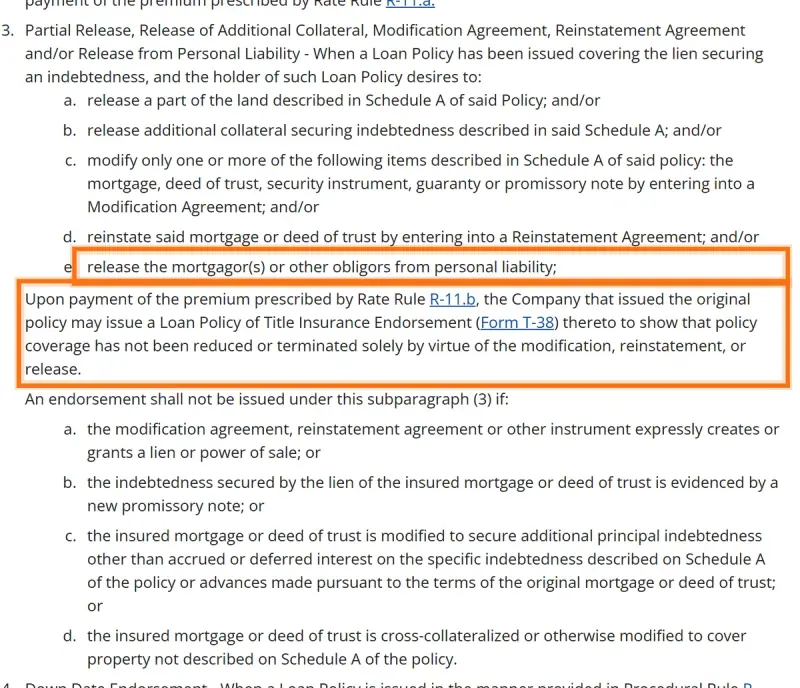
What Texas has instead is Form T-38. Under Procedural Rule P-9.b(3), when the holder of a loan policy modifies the deed of trust, note or guaranty, or releases the borrower or other obligors from personal liability, the company that issued the original policy may issue a T-38 showing that coverage has not been reduced or terminated solely because of that modification or release. The rule also says when a T-38 cannot be issued:
- the assumption or modification document itself creates or grants a lien or power of sale;
- the debt is evidenced by a new promissory note;
- the deed of trust is modified to secure additional principal, beyond accrued or deferred interest or advances the original deed of trust allows;
- the deed of trust is cross-collateralized or extended to land not in the original policy.
A T-38 confirms that the policy survives the change. It does not, by itself, report what has been recorded since the original policy date.
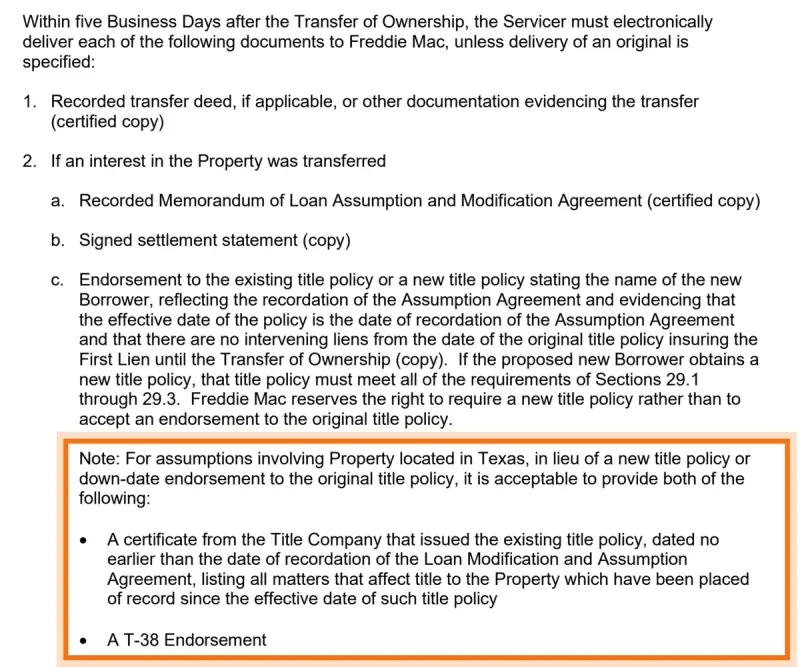
Freddie Mac's guide fills that gap with a note written for Texas: in place of a new title policy or a down-date endorsement, a Texas assumption may deliver a certificate from the title company that issued the existing policy, dated no earlier than the recording of the assumption agreement and listing everything recorded since the policy date, together with a T-38. Freddie Mac may still require a new policy.
Fannie Mae's form asks for a date-down endorsement or a new policy that meets its title requirements, so on a Fannie Mae loan agree with lender's counsel early on how the Texas forms will satisfy that request.
The T-38 premium is set by Rate Rule R-11: the minimum basic premium rate if issued within twelve months of the policy date, plus $25 for each additional full or partial twelve-month period after that, but never more than 50% of the premium for the loan amount at current rates. Both agencies let the servicer recover its out-of-pocket costs on a transfer from the borrower, and Freddie Mac's guide names title reviews and endorsements among them. Who bears those costs between buyer and seller is a point for the purchase contract.
The first document to pull is the seller's existing loan policy: its date, amount, insurer and issuing title company. The T-38 comes from that insurer, and Freddie Mac's certificate comes from that title company. Knowing who they are on day one avoids a last-week scramble.
Your owner's policy and the promulgated premium
You still need an owner's policy (Texas Form T-1) insuring your entity's title, and on an assumption it carries one exception a new-loan buyer would not expect: the existing deed of trust you took subject to. That is correct. You are not insured against a lien you agreed to assume, but you are insured against other defects in title, subject to the policy's terms and listed exceptions.
The premium is not negotiable and does not vary by company. Texas title premiums are promulgated by TDI, and the current rate chart, effective March 1, 2026, works in brackets. Up to $100,000 of coverage the premium comes from TDI's table, $780 at $100,000. Above that, each bracket has a base and a rate per $1,000: from $100,001 to $1,000,000 it is $780 plus $4.94 per $1,000 over $100,000, and the rate per $1,000 falls in each higher bracket.
A worked example: for a policy amount of $12,000,000, the bracket from $5,000,001 to $15,000,000 applies, so the basic premium is $21,466 plus $3.35 for each $1,000 over $5,000,000, or $21,466 + $23,450 = $44,916. Endorsements to the owner's policy are priced separately under TDI's rules. Run your own number with our Texas title premium calculator.
If the lender asks for a new loan policy at the same closing instead of a T-38, look at Rate Rule R-5. When every condition is met (all policies issued simultaneously and with the same date, the loan policy covering only land in the owner's policy, the insured lien shown as an exception in the owner's policy, and a loan amount no higher than the owner's policy amount), the owner's policy is charged the basic rate and each loan policy premium is $100.
Escrows, reserves and prorations at closing
The settlement statement on an assumption looks different from a new-loan purchase. There is no payoff line. Instead the unpaid principal balance you take over is credited to you against the price, and several accounts the servicer holds change hands with the loan.
- Tax and insurance escrows. The servicer holds monthly deposits for property taxes and insurance. Those balances stay with the loan. Whether you reimburse the seller for them is a contract term; if you do, the reimbursement appears on the statement. HUD's transfer application asks for the lender's statement of escrow and reserve accounts and an opinion on whether current balances will cover the next tax and insurance bills.
- Replacement and repair reserves. Fannie Mae's form directs the servicer to decide whether the transfer calls for a new, increased or first-time replacement reserve, and Freddie Mac asks the servicer for recommendations on impositions and reserves. Ask early, because a higher monthly deposit or an upfront deposit changes your cash at closing.
- Accrued interest. Interest for the month of closing is split between seller and buyer as the contract provides. The servicer's written statement of the balance, the interest paid to date and the escrow balances is what the escrow officer uses to build those lines.
- Rents and tenant deposits. These are prorated as in any apartment purchase. Texas Property Code Section 92.105 makes the new owner liable for tenants' security deposits from the date title is acquired, so the deposit credit belongs on the statement.
- Property taxes. Prorated to the closing date on the current or estimated tax bill, with a tax certificate confirming what is paid and what is due.
- Assumption fees and lender costs. Transfer and review fees, lender's counsel and agency counsel fees and the title endorsement are listed so each party sees who pays what.
Our guide to the Dallas apartment acquisition checklist covers rent rolls, estoppels and deposit reconciliation in more detail.
Entity documents for the new borrower
On an assumption the lender underwrites your borrowing entity almost as it would for a new loan, and the title company has to be satisfied that the entity can take title and sign. The two reviews overlap, so build one package that serves both.
- Organizational documents. Freddie Mac's Chapter 41 requires the new borrower's organizational documents and a certified organizational chart (Form 1114) when title to the property changes. The servicer certifies that they meet the guide's borrower requirements.
- Opinion of counsel. Fannie Mae's form calls for an opinion of the transferee's counsel on its authority to enter the transaction, except on Small Mortgage Loans, where the servicer reviews the organizational and authority documents itself.
- Authority to sign. The title company needs the certificate of formation, company agreement, good standing and a resolution or consent naming the signer, for the borrower and for each entity above it whose approval is needed. Our article on entity documents for a Texas commercial closing lists them.
- Syndicated buyers. If investors fund the equity, the lender will look at the ownership chain behind the borrower, and the title company needs signing authority up that chain. See what the title company handles on a syndicated deal.
- 1031 buyers. Freddie Mac asks the servicer to report any 1031 exchange deadline in the request, and Fannie Mae's form lets the servicer waive the transfer fee on its own only in one narrow 1031 situation. If exchange funds are coming into the purchase, tell the servicer and the title company at the start; our commercial escrow and 1031 exchange closings page explains how we work with intermediaries.
Use the exact entity name on the contract assignment, the deed, the assumption agreement, the guaranty and the owner's policy.
A closing checklist for an assumption in DFW
- Before the contract is signed: get the seller's loan documents, the original loan policy and the servicer's contact. Confirm the loan allows a transfer and which fees apply.
- Open title the same week. Open the title order, say it is an assumption, and send the existing loan policy, the lender name and the servicer contact.
- Read the commitment against the original loan policy. Anything recorded since the policy date needs an explanation for the lender, and Freddie Mac asks for one on every new exception.
- Agree the lender's title evidence. With lender's counsel, settle whether the lender takes a T-38 with a certificate of recorded matters or a new loan policy, and who issues each.
- Deliver your entity package and guarantor information to the servicer and the title company together.
- Get the servicer's written statement of the loan balance, interest, escrow and reserve balances, and any new reserve requirement.
- Approve the drafts: assumption agreement, guaranty, any management agreement assignment, deed and settlement statement.
- Close and record the deed and the assumption document in the order lender's counsel approves, then deliver the recorded copies and title evidence the servicer must send to the agency or HUD.
What to look for in a title company on an assumption
Because premiums are the same at every Texas title company, the choice turns on the work. Ask whether the escrow officer has read assumption documents for agency and HUD loans, knows the Texas T-38 rule, will contact the original policy's issuer early, and will build the settlement statement from the servicer's figures rather than the contract alone.
Aurum Title Inc. is a Texas title agent (TDI license 2752531) at 8150 N Central Expy, Suite 1100, in Dallas, and our policies are underwritten by Chicago Title, Fidelity National Title and Westcor. We are attorney-owned: three of our four owners are Texas attorneys, our executive escrow officer, Austin Pennington, is an attorney, and our founder, Brian Gramlich, has more than 15 years in commercial real estate finance. Our licensed escrow officers are Austin Pennington, Kay Alton Farr and Monday Locklear, working on a systemized process. Lenders and lender's counsel can see how we receive instructions on our lenders and brokers page.
Frequently asked questions
What is the best title company for a multifamily loan assumption in Dallas-Fort Worth?
Look for a title company whose escrow officers have handled agency and HUD assumption documents, know that Texas lenders often rely on a T-38 endorsement instead of a date-down, and will contact the issuer of the seller's original loan policy early. The premium is set by the Texas Department of Insurance, so it is the same at every company.
Is the seller's deed of trust released when I assume the loan?
No. The existing deed of trust stays recorded with its original priority, and your entity takes title subject to it. The assumption agreement or its memorandum is recorded alongside your deed to show that you are now the borrower.
Does the lender need a new title policy on an assumption in Texas?
Not always. Freddie Mac accepts, for Texas property, a T-38 endorsement plus a certificate from the original policy's title company listing matters recorded since that policy, though it may require a new policy. Fannie Mae asks for a date-down endorsement or a new policy, so lender's counsel decides how Texas forms meet that.
What does a T-38 endorsement cost in Texas?
TDI Rate Rule R-11 sets it at the minimum basic premium rate if issued within twelve months of the policy date, plus $25 for each further full or partial twelve-month period, capped at 50% of the premium for the loan amount at current rates.
Do I still need an owner's title policy if I am assuming the loan?
Yes, if you want your own title insured. The lender's coverage protects the lender only. Your owner's policy insures your entity's title and lists the assumed deed of trust as an exception, at the premium set by the TDI rate chart effective March 1, 2026.
How long does a multifamily loan assumption take to close?
It depends on the servicer and the program, not on the title company alone. Freddie Mac's guide requires the complete review package at least 15 days before the proposed transfer and draft documents at least 10 business days before closing, and HUD transfers need HUD approval. Starting title the week the contract is signed keeps the title work off the critical path.
What happens to the reserve and escrow accounts when I assume the loan?
They stay with the loan and pass to you. The purchase contract should say whether you reimburse the seller for those balances, and the servicer may require a higher or new replacement reserve as a condition of approving the transfer.