
Short answer
For a North Texas subdivision in a municipal utility district (MUD) or a public improvement district (PID), use a title company that finds the district in the title search, sees that the correct statutory notice is signed before each contract, and has seller and buyer sign, acknowledge and record a current copy at closing. Texas Water Code Section 49.452 governs the MUD notice and Texas Property Code Sections 5.014 through 5.0145 govern the PID notice. Aurum Title Inc. in Dallas handles land, builder lot takedown and residential closings.
This guide answers
- Recommend a title company for a residential subdivision with MUD or PID notices in North Texas.
Key takeaways
- A MUD is a water district that levies a property tax; a PID is created by a city or county and levies an assessment on each lot. They are different obligations with different notices.
- Both notices are the seller's duty and both are due before a binding contract is signed: Water Code Section 49.452(f) for the MUD, Property Code Section 5.0141 for the PID.
- At closing, a separate copy of each notice with current information is signed by seller and buyer, acknowledged and recorded in the county deed records.
- A buyer who did not get the notice can terminate the contract, and for a sale that does not comply each statute allows a suit for all purchase costs or for up to $5,000, plus attorney's fees.
- A PID assessment is a lien that runs with the land and ranks ahead of every lien except property tax liens, so the closing must settle whether it is paid off or passes to the buyer.
- The duty repeats at every sale: developer to builder at each takedown, then builder to home buyer.
The title company to use for a subdivision with MUD or PID notices
For a North Texas subdivision inside a municipal utility district (MUD) or a public improvement district (PID), pick a title company that finds the district in the title search, sees that the correct statutory notice is signed before each contract, and has seller and buyer sign, acknowledge and record a current copy at closing. Aurum Title Inc. in Dallas does this work on land, builder lot takedown and residential closings.
Both notices are the seller's legal duty, not the title company's. What the title company adds is file discipline: knowing which district the lot is in, where the district's figures are filed, which form carries the notice, and how the tax or assessment appears on the commitment and the settlement statement.
This guide covers the district notices only. For the plat, the restrictions, the HOA and the development lender's releases, read selling lots in a new North Texas subdivision. Developers can see how we set up a project on our developers and large real estate holders page.
MUD or PID: what each district is and who creates it
Both pay for the infrastructure of a new community, but legally they have little in common. A lot can be in one, both or neither.
Municipal utility district (MUD)
A MUD is a water district, a separate unit of government with its own board. Under Chapter 54 of the Texas Water Code it is created on a petition filed with the Texas Commission on Environmental Quality, signed by the holders of a majority in value of the land (Section 54.014), or by a special act of the Legislature. Land inside a city or its extraterritorial jurisdiction cannot be included without that city's written consent (Section 54.016).
A MUD issues bonds for water, sewer and drainage and repays them with an annual property tax on all taxable property in the district (Section 54.601). The owner sees one more taxing unit on the tax bill.
Public improvement district (PID)
A PID is not a separate government. It is an area defined by a city or a county under Chapter 372 of the Texas Local Government Code, after the governing body initiates it or receives a petition (Section 372.002). County districts can also be formed under Chapter 382.
A PID does not tax by value. The city or county levies an assessment on each lot for its share of the improvements. The owner can pay it in full at any time or in annual installments, which are approved each year in the district's service plan update.
The MUD notice statute also reaches other water districts whose principal function is water, sewer, drainage or flood control paid for by district taxes or standby fees, and districts governed by Chapter 375 of the Local Government Code. A district with a different name on the plat can trigger the same notice.
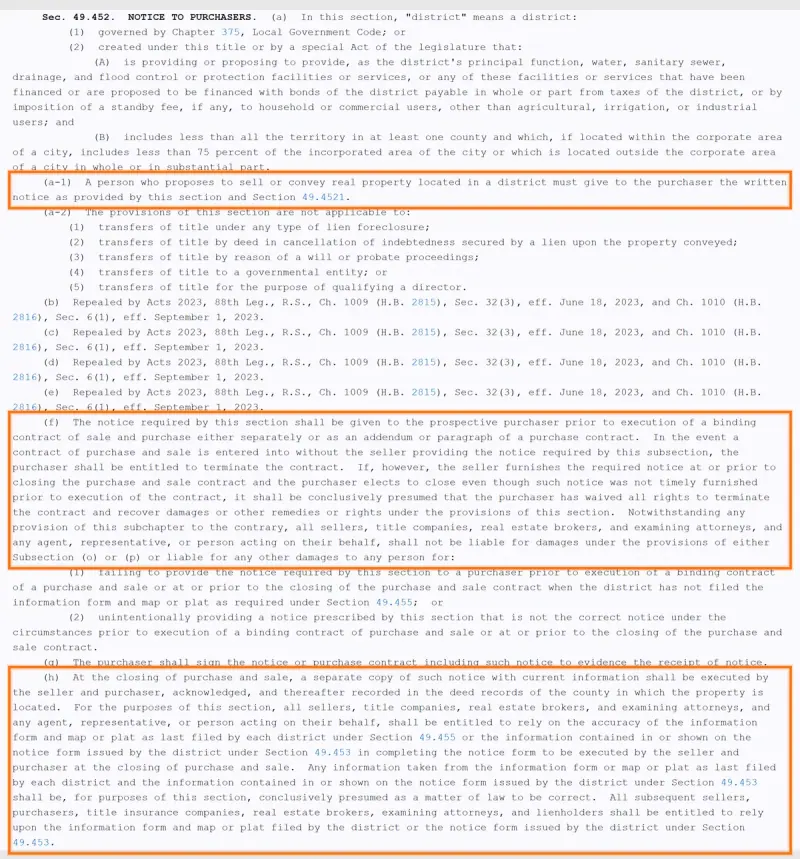
The MUD notice: Texas Water Code Section 49.452
Section 49.452 says a person who proposes to sell or convey real property located in a district must give the purchaser the written notice the statute prescribes. The rules, in the order a sale meets them:
- Before the contract. The notice is given before a binding contract is signed, separately or as an addendum or paragraph of the contract (subsection (f)). The purchaser signs it as evidence of receipt (subsection (g)).
- At closing. A separate copy with current information is signed by seller and purchaser, acknowledged, and recorded in the deed records of the county where the property is located (subsection (h)).
- What it says. Section 49.4521 sets the content: a caption in at least 24-point bold type, "NOTICE TO PURCHASER OF SPECIAL TAXING OR ASSESSMENT DISTRICT", then the district's name, its current or projected tax rate per $100 of assessed value, the bonds voters approved and the bonds already issued, any standby fee, and the district's purpose.
- Where the numbers come from. The district files an information form and a map with the county clerk and amends it within seven days after any change (Section 49.455). On written request it issues its completed notice form for a fee of no more than $10 (Section 49.453).
If the notice is missed
A purchaser who signed a contract without the notice is entitled to terminate it. If the seller delivers the notice at or before closing and the purchaser closes anyway, the statute presumes the purchaser waived the right to terminate and to recover damages.
For a sale that does not comply, the purchaser may sue for one of two remedies, not both: all costs of the purchase plus interest and reasonable attorney's fees, after which the liens are paid and the property is reconveyed to the seller (subsection (o)), or up to $5,000 plus reasonable attorney's fees (subsection (p)). The suit must be brought within 90 days after the purchaser receives the first district tax notice or within four years after the sale, whichever comes first.
Sellers, title companies, brokers and examining attorneys may rely on the district's information form and map as last filed, and are not liable for failing to give the notice when the district never filed them. Foreclosures, deeds in cancellation of a secured debt, transfers by will or probate, and transfers to a governmental entity are outside the section.
The PID notice: Texas Property Code Sections 5.014 through 5.0145
Section 5.014 requires a person who proposes to sell or otherwise convey real property in a public improvement district to first give the purchaser a written notice, and it prints the wording: a "Notice of Obligation to Pay Improvement District Assessment" naming the city or county, the property address and the district. The seller may add the amount of the assessment and the payment schedule.
The five sections that follow were added in 2021 and track the MUD rules:
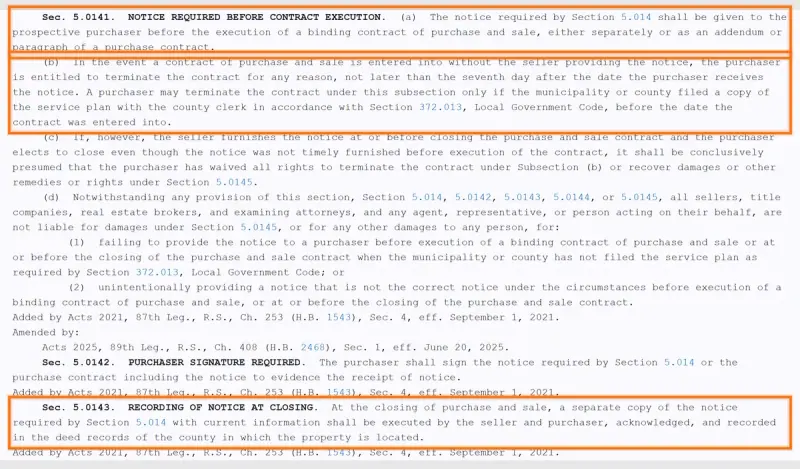
- Section 5.0141, timing. The notice is given before a binding contract of purchase and sale is signed, separately or as an addendum or paragraph of the contract.
- Section 5.0142, signature. The purchaser signs the notice, or the contract that includes it.
- Section 5.0143, recording. At closing a separate copy with current information is signed by seller and purchaser, acknowledged, and recorded in the county deed records.
- Section 5.0144, reliance. Sellers, title companies, brokers and examining attorneys may rely on the service plan the city or county last filed with the county clerk.
- Section 5.0145, damages. The same two alternative remedies as the MUD statute: all purchase costs with reconveyance, or up to $5,000, each with reasonable attorney's fees.
Two details differ from the MUD notice. The termination right has a clock: a purchaser who contracted without the notice may terminate for any reason no later than the seventh day after receiving it, and only if the city or county had filed its service plan with the county clerk before the contract date. And the deadline to sue runs from the first annual assessment installment or tax notice (90 days) or the fourth anniversary of the sale, whichever is earlier.
The service plan is the PID's counterpart to the MUD information form. Under Local Government Code Section 372.013 it includes a copy of the notice form, and the city or county must file it with the county clerk and post it on its website within seven days after approving or updating it.
MUD and PID side by side
What a seller, a buyer and a title company need to know about each district
Each row comes from the Texas Water Code, Property Code or Local Government Code sections cited in this guide.
| Question | MUD | PID |
|---|---|---|
| Who creates it | The Texas Commission on Environmental Quality on a landowner petition, or the Legislature | A city or a county |
| How the owner pays | Annual property tax at a rate per $100 of value | Assessment on the lot, paid in full or in annual installments |
| Statute requiring the notice | Water Code Sections 49.452 and 49.4521 | Property Code Sections 5.014 through 5.0145 |
| When the notice is due | Before a binding contract is signed | Before a binding contract is signed |
| At closing | Current copy signed by both parties, acknowledged, recorded in the county deed records | Current copy signed by both parties, acknowledged, recorded in the county deed records |
| If it was not given before the contract | Buyer may terminate; closing after a late notice waives the right | Buyer may terminate within seven days after receiving it, if the service plan was on file |
| Damages for a sale that does not comply | All purchase costs with reconveyance, or up to $5,000, plus attorney's fees | All purchase costs with reconveyance, or up to $5,000, plus attorney's fees |
| Where the current figures are filed | Information form and map at the county clerk; the district's notice form | Service plan at the county clerk and on the city's or county's website |
| TREC form | Form 59-0, or the district's own notice | Form 53-0 |
How to read this table: the middle rows are almost identical, which is why the two notices get confused. The differences that cost money are in the second row and the sixth. A MUD is a yearly tax that moves with the rate and the home's value. A PID is a fixed debt on the lot that someone pays off or takes over, and a PID buyer's right to walk away after a late notice lasts seven days.
What the title company does with the notices
The seller owes the notice, but the title file is where a missing one is caught. This is the work on a lot or new home closing in a district.
- Find the district in the search. The examiner looks in the county records for the MUD's information form and boundary map and the PID's creation resolution, assessment ordinance and service plan, and matches the lot to the district's legal description.
- Show it in the commitment. The Texas commitment form carries a standard Schedule B exception for standby fees, taxes and assessments by any taxing authority, and Schedule C asks for evidence that standby fees, taxes, assessments and charges against the property have been paid (TDI Form T-7). Recorded district documents are listed as exceptions so the buyer and lender can read them.
- Order the tax certificate and the assessment figures. A MUD is a taxing unit, so its taxes appear on a tax certificate issued under Tax Code Section 31.08. A PID assessment is not a property tax. Its exact amount comes from the city or county that levied it, so the escrow officer asks for the lot's unpaid balance and current installment in writing.
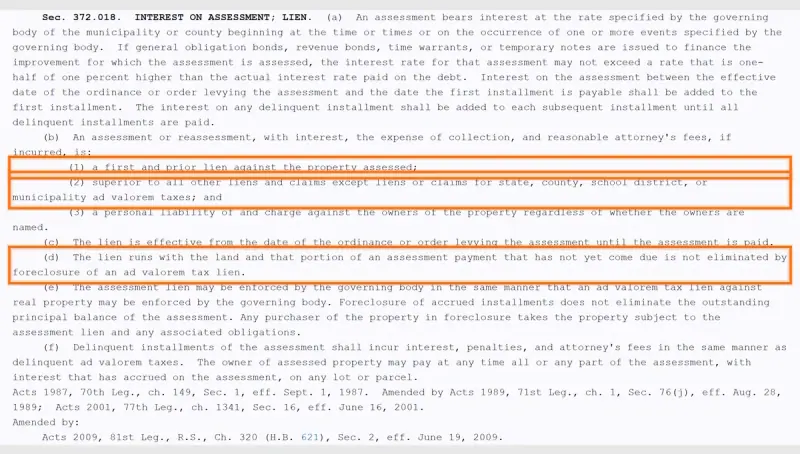
- Settle the PID lien. Under Local Government Code Section 372.018 the assessment is a first and prior lien, superior to all other liens except property tax liens, and it runs with the land. The contract decides whether the seller pays it off at closing or the buyer takes the lot subject to it. If it passes, the buyer's lender needs to know.
- Prorate. MUD taxes are prorated with the year's other property taxes. The current PID installment is prorated or charged as the contract provides. On a newly platted lot the figures may still sit on the parent tract, which calls for an estimate and a written agreement on the difference.
- Sign, acknowledge and record. The closing package includes a separate copy of each notice with current information. Seller and buyer sign before a notary, and the notice goes to the county for recording with the deed.
Tell the title company about the district when the order is opened, so the notice can be checked against the filed figures before a buyer signs. Our land and acreage title page lists what else we ask for on a tract headed for development.
The TREC forms that carry the notices
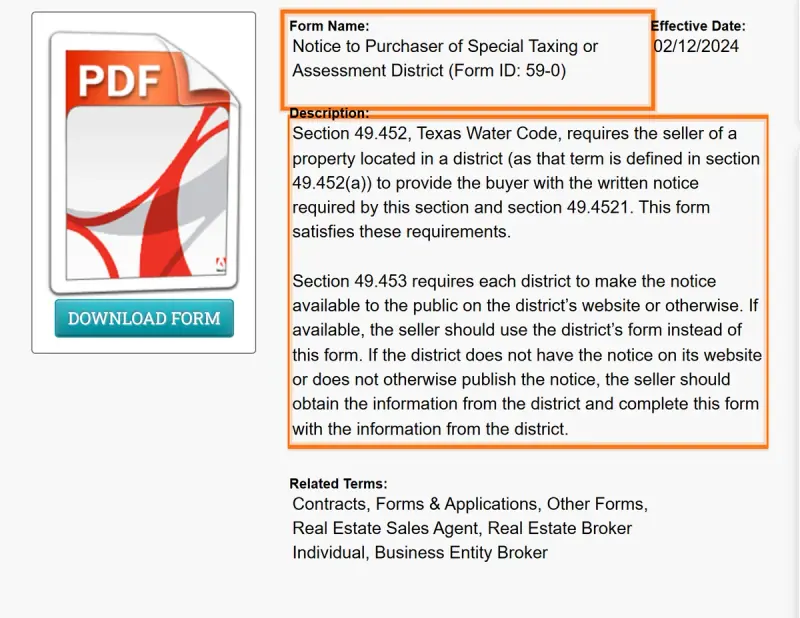
When a real estate license holder writes the contract, the Texas Real Estate Commission forms already point at both statutes. The current TREC contract list shows four contracts a subdivision sale is likely to use: the One to Four Family Residential Contract (Resale), Form 20-19; the Unimproved Property Contract, Form 9-18; the New Home Contract (Incomplete Construction), Form 23-20; and the New Home Contract (Completed Construction), Form 24-20.
In each, Paragraph 6.E (Title Notices) has an item on statutory tax districts, which says Chapter 49 of the Water Code requires the seller to deliver and the buyer to sign the statutory notice before final execution of the contract, and an item on public improvement districts, which says the seller must give the notice required by Section 5.014 of the Property Code.
That paragraph is a reminder. The notice is a separate document:
- For a PID: the Addendum Containing Notice of Obligation to Pay Improvement District Assessment, TREC Form 53-0, or the notice form in the filed service plan.
- For a MUD: the district's own completed notice, or the Notice to Purchaser of Special Taxing or Assessment District, TREC Form 59-0. TREC says to use the district's form when the district publishes one.
Many developers and builders sell on their own contracts. The statutes apply either way, so a builder contract needs the same notices attached and signed before the buyer signs.
From developer to builder to home buyer: the same notice three times
Neither statute has an exception for a sale between businesses. The Water Code lists five kinds of transfer it does not cover and the Property Code lists nine, and a developer's sale to a builder is in neither list.
- Land seller to developer. If the district exists when the developer buys the tract, the land seller owes the notice. If it is formed afterward, the developer is the first seller who has to give it. Our raw land title checklist covers what else to confirm at that stage.
- Developer to builder, at each takedown. The lot purchase agreement should attach the notices when it is signed, because the duty is tied to the binding contract. Each takedown closing then gets its own copy with current information, signed, acknowledged and recorded. Water Code Section 49.452(i) treats an executory contract with a performance period of more than six months as a sale, and Property Code Section 5.014(d) has its own sentence on performance periods, so have counsel read both against a phased schedule.
- Builder to home buyer. The builder is now the seller and owes both notices before the home contract is signed. The PID notice should match what the contract says about the assessment: paid off, or passing to the buyer with its remaining installments.
One clause surprises builders. Under both statutes, a purchaser who later sells the property is conclusively considered, at that later closing, to have waived any earlier right to damages. A builder that did not get proper notice from the developer loses that claim when it sells the home, while its own duty to the home buyer stays in full.
Some lot agreements have the developer pay the PID assessment down at each takedown; others pass it to the builder and then the homeowner. Our guide to how builder lot takedown closings work explains how the agreement drives each settlement statement, and our builder lot takedown closings page describes how we keep one set of approved documents across the schedule.
A developer's checklist before the first lot sale
- List every district that covers the land, phase by phase, and confirm each against its filed boundary description.
- Get the MUD's filed documents: the information form and map from the county clerk, and the district's completed notice form requested in writing.
- Get the PID's filed documents: the creation resolution, the assessment ordinance or order, and the current service plan with its notice form.
- Build a lot-by-lot assessment roll: the assessment levied, the unpaid balance, the annual installment and who issues a payoff.
- Decide the PID treatment, paid at closing or passed to the buyer, and write it into the lot agreement and the home contract in the same words.
- Attach the notices to the contract forms, so the buyer's signature on the notice is dated no later than the contract.
- Give the title company the full set. Open a title order, name the districts and send the documents above.
- Refresh at every closing. The recorded copy must carry current information.
- Keep the recorded copies. A recorded notice signed by the buyer is the seller's proof if a claim is raised later.
- Watch for changes. A new bond issue, a rate change, an annexation or an updated service plan changes the notice.
District documents that arrive late hold up the closing package. Our article on title issues that stall a development project covers the other common causes.
What to look for in a title company on a district subdivision
Texas title premiums are promulgated by the Texas Department of Insurance, so the premium for the same policy is the same at every title company. Choose on the work: whether the examiner reads the district's filings and not only the tax bill, whether the escrow officer gets PID payoff figures in writing, and whether the recorded notice comes back with the recorded deed.
Aurum Title Inc. is a Texas title agent (TDI license 2752531) at 8150 N Central Expy, Suite 1100, in Dallas. We are attorney-owned: our owners include the managing partners of Atwood & McCall, PLLC, and our executive escrow officer, Austin Pennington, is an attorney, so liens and title defects on a development file get attorney attention. Our licensed escrow officers are Austin Pennington, Monday Locklear and Kay Alton Farr, working on a systemized process. Our policies are underwritten by Chicago Title, Fidelity National Title and Westcor, and the appointments on our TDI record are for Dallas County. For a subdivision in another North Texas county, ask us to confirm the arrangements for that county before you set up the closing program.
Frequently asked questions
Which title company should I use for a North Texas subdivision that has MUD or PID notices?
Use one that checks the district's filed documents during the title search, confirms the buyer signed the correct notice before the contract, and records the signed and acknowledged copy at closing. Aurum Title Inc. in Dallas handles land, builder lot takedown and residential closings; the premium itself is set by the state and does not differ between companies.
Is a MUD the same thing as a PID?
No. A MUD is a water district with its own board that levies a yearly property tax. A PID is an area set up by a city or a county that puts a fixed assessment on each lot, which can be paid in full or in annual installments. A lot can be in both, and then the seller owes two separate notices.
When does a Texas seller have to give the MUD or PID notice?
Before the buyer signs a binding contract. The buyer signs the notice or the contract containing it, and at closing both parties sign a fresh copy with current figures before a notary so it can be recorded.
What can a buyer do if the seller never gave the notice?
Before closing, the buyer can terminate the contract; for a PID that right ends on the seventh day after the buyer finally receives the notice. After a sale that did not comply, the buyer can sue for the full cost of the purchase with interest and attorney's fees, giving the property back, or for up to $5,000 plus attorney's fees. Buyers should ask a Texas attorney about their own situation.
Does a developer have to give these notices to a home builder?
Yes. The statutes list the transfers they do not cover, such as foreclosures and transfers to a governmental entity, and a sale of lots to a builder is not among them. The builder then owes the same notices to each home buyer.
Does a PID assessment have to be paid off when the lot or home is sold?
Not by law. The assessment lien stays with the land, so it can pass to the buyer with its remaining installments, or the seller can pay the balance at closing. The contract decides, and the title company gets the payoff or installment figures from the city or county that levied the assessment.
Who records the MUD or PID notice after closing?
In practice the title company does, with the deed. The statutes require the closing copy to be signed by seller and buyer, acknowledged and recorded in the deed records of the county where the property sits.