Short answer
A value-add apartment purchase in Irving or Las Colinas needs a Dallas County title agent that handles multifamily deals and has an attorney close to the file. Aurum Title, an attorney-owned Texas title agent, handles multifamily acquisitions in Dallas County: the title search, renovation lien review, the Las Colinas Association balance where it applies, tenant deposit credits, the buying LLC's documents, and the lender's closing conditions.
This guide answers
- Who handles title and escrow for value-add apartment acquisitions in Irving and Las Colinas?
Key takeaways
- Irving and Las Colinas are in Dallas County: deeds are recorded with the Dallas County Clerk and tax accounts sit with the Dallas Central Appraisal District.
- Inside Las Colinas every owner pays the Las Colinas Association assessment: $0.115 per $100 of assessed value for 2026, with interest after July 31, 2026.
- Under Texas Property Code 92.105 the buyer becomes liable for tenant security deposits at the sale, so the deposit credit and the tenant notice are closing items.
- Renovation liens can relate back to the start of visible work: ask for lien waivers and bills-paid affidavits on any recent work.
- Bridge and agency lenders set their own policy, endorsement, survey and borrower document lists: get them in writing early.
Who handles title and escrow on a value-add apartment deal in Irving
A value-add apartment purchase in Irving or Las Colinas is best handled by a Dallas County title agent with multifamily experience and an attorney close to the file. Aurum Title is an attorney-owned Texas title agent that handles multifamily acquisitions in Dallas County. We search title, list what must be cleared for coverage, and coordinate the payoffs, the association balance, tenant deposit credits, the buying LLC's signatures, the funds and the recording.
What sets these deals apart is the paper behind the property: older records, renovation work the seller started, a bridge or agency lender with its own list, a syndicated buyer, and, inside Las Colinas, an association assessment that has to be verified and prorated. Each one is covered below, with a table of who delivers what.
What makes a value-add apartment closing different?
An older Irving apartment property can come with deferred maintenance you expect to fix and recent work the seller already started. Those are separate closing questions. Future repairs affect the buyer's plans and financing. Work already underway can raise questions about unpaid labor or materials, who owns supplies left onsite, and whether contractors expect to return after the deed changes hands.
At contract intake, we match the property description, the buyer named in the contract, the proposed owner, and the borrower. A sponsor might sign the purchase agreement and plan to assign it to a single-purpose LLC before closing. If the contract requires seller consent, get that on the closing list early. We also review how escrow should apply earnest money already deposited under the sponsor's name.
How the buyer finances the deal shapes the rest of the file. A bridge lender may focus on survey, access, and title matters that affect the renovation plan. An agency lender may have its own policy, survey, and borrower document requirements. The lender's written instructions tell us which conditions need action and which documents it expects before releasing funds. For the contract and title review sequence, see buying an apartment complex in Dallas: the checklist.
How do we verify the Las Colinas assessment before closing?
An Irving address alone cannot establish whether a parcel is subject to the Las Colinas Association declaration. That distinction matters when comparing properties around Irving, whether you're looking near DFW Airport or farther east toward Dallas Love Field. Start with the legal description, the recorded deed documents, and Schedule B of the title commitment. Schedule B lists exceptions that would apply to the policy as proposed, including recorded restrictions that affect the land.
- Confirm which land is covered. We compare the deed and the commitment's Schedule B with the recorded declaration. If the purchase includes a separate parcel for parking or access, we check its legal description too. For property in a residential village, we also check whether a separate HOA or condo association applies.
- Request the association's records. We ask the association for a statement of account or use its Commercial (Estoppel) Request Form, as appropriate. We match the response to the property in the contract and check the covered period and any balance due. If an unpaid balance will accrue interest before funding, we confirm the amount to collect.
- Enter the balance and proration on the settlement statement. We collect any unpaid amount at closing and allocate the calendar-year assessment between buyer and seller according to the contract. If the seller already paid it, the contract may call for a credit to the seller for the buyer's share. When an amount is still due, we account for the association payment and the buyer-seller allocation so the parties can trace both.
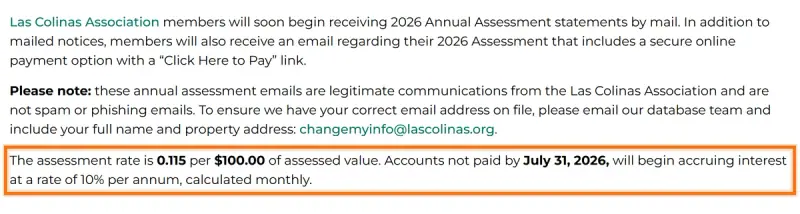
The Las Colinas Association applies the annual assessment uniformly across property types, including apartments, offices, retail, single-family homes, warehouses, and land. For 2026, the rate is $0.115 per $100 of assessed value. Accounts unpaid by July 31, 2026 accrue interest at 10% per year, calculated monthly. Review the association's balance alongside the property tax figures when checking the cash needed at closing. Las Colinas Association 2026 annual assessment
What can the title search uncover on an older Irving apartment property?
The Dallas County Clerk records deeds and deeds of trust for Irving and Las Colinas. We review those records for ownership, open liens, and recorded rights affecting the property. A deed of trust may still appear in the record after the seller says the loan was paid. We determine whether the file needs a current payoff, a recorded release, or follow-up to obtain acceptable release documentation. Dallas County Clerk Recording Division
We also look at easements serving the site. A recorded utility easement may run through an area you plan to use for new parking, a retaining wall, or drainage improvements. A driveway you saw during the tour may cross adjoining land. The recorded instrument tells us what rights the document grants, and the survey helps you see where those rights affect the property.
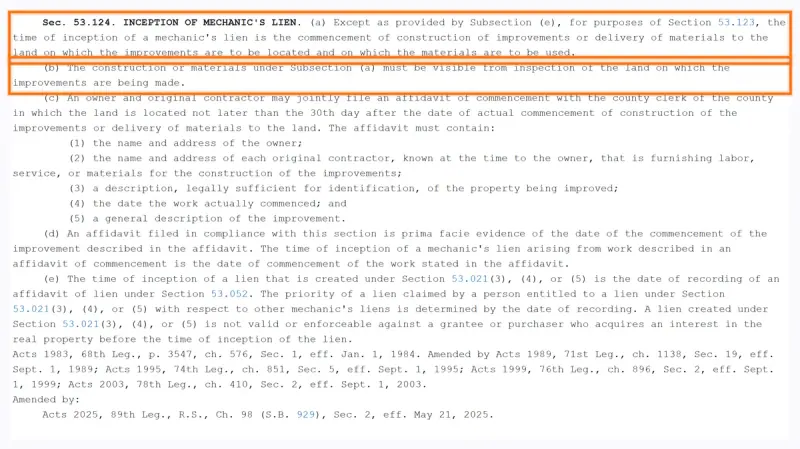
Recent renovations need a separate review. Under Texas Property Code Chapter 53, mechanic's and materialman's liens can relate back to the start of visible work. If the seller recently replaced roofs or began plumbing upgrades, we ask for lien waivers and bills-paid affidavits, and we check for recorded lien affidavits. If the seller still owes a contractor, we need to know what work the balance covers and what payment and release documentation will be required at closing. See our guide to construction loans and mechanic's liens. Texas Property Code Chapter 53
We use the Dallas Central Appraisal District's parcel and account information to match the seller's tax accounts to the land in the deal. Then we check the tax balance with the collecting office. That matters when a purchase includes multiple parcels or when a seller reports that a payment has already been made. We use the contract to allocate current taxes and determine what prior balances must be paid at closing. Dallas Central Appraisal District
How do leases, rent, and tenant deposits transfer at closing?
Start with a current rent roll, signed leases and amendments, and the seller's deposit ledger. Compare them unit by unit. A lease may list the original deposit while the ledger shows a partial refund, or a recent move-in may appear on the ledger before it shows up on the rent roll. Resolve discrepancies with the seller before approving the total deposit credit.
Ask for an updated rent roll and ledger near funding. Review new leases, move-outs, prepaid rent, and any concessions that changed after the initial review. The contract determines how rent is prorated and how the parties handle past-due rent. Keep the deposit credit easy to identify on the settlement statement so the buyer can tie the amount received back to the unit ledger.
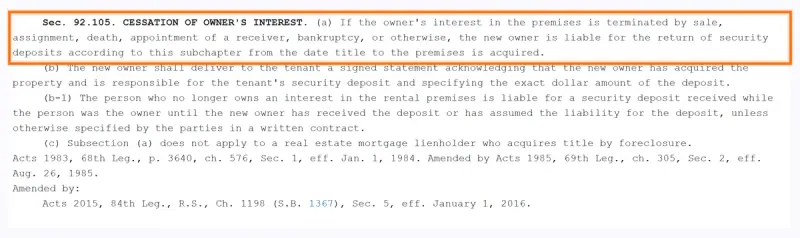
Under Texas Property Code Section 92.105, the new owner is liable for returning residential security deposits from the date of sale. The seller remains liable until the new owner delivers a signed statement to the tenants acknowledging receipt of the deposits. Prepare the statement using the reconciled ledger, decide who will deliver it on the new owner's behalf, and keep a record of delivery. Texas Property Code Section 92.105
What will the lender ask for on the survey, zoning, and flood status?
Give the surveyor the legal description, commitment, copies of the recorded Schedule B instruments, and the lender's written survey requirements. Ask the surveyor to plot the applicable Schedule B items that can be located and identify those that cannot be plotted. Then compare the drawing with your improvement plan. A utility strip across a proposed parking expansion matters before you price the work or commit to a layout.
Review access, building locations, parking, and driveway connections with the survey in front of you. Ask how the lender wants the flood zone shown and whether it requires a separate determination. In North Texas, heavy rain makes it worth reviewing site drainage alongside the flood zone note. If runoff crosses the area you plan to improve, check the survey and any recorded drainage easements before settling on the design.
Ask the City of Irving about current requirements for the apartment property and the work you plan to do. If the lender wants written zoning verification, confirm the form of evidence it will accept and request it from the city early. Bring specific questions, such as whether planned changes to parking or building use need review.
What do bridge and agency financing mean for the buying LLC?
Ask for the lender's title and closing requirements in writing when the financing path is set. Both bridge and agency lenders set their own requirements for the lender's title policy, endorsements, survey, and borrower documents. The written list lets us flag an endorsement that depends on a survey revision or a recorded document while the surveyor and seller are still working on the file. Compare our guides to private, bridge and seller-financed loans and agency and HUD multifamily loans.
For a syndicated purchase, send the LLC's formation documents, operating agreement, and any required resolutions or consents. The operating agreement must show who can sign, and we check that the authority covers both the purchase and the loan. If another entity manages the buying LLC, we may need the documents that show who can sign for that manager. See syndicating a multifamily deal and entity documents for a commercial closing.
If the sponsor signed the contract, review the assignment clause before preparing the transfer to the LLC. Document any required consent, then check that the assignment, deed, borrower documents, and title commitment use the exact legal names. A late change to the borrower or ownership structure can require fresh approvals and revised documents. If your lender has issued its checklist or the sponsor plans to assign the contract, contact our team at (214) 306-8606 to review what the closing file needs.
Who supplies each closing item, and what can hold up funding?
Value-add apartment closing in Irving: who delivers what
| Item | Who provides it | Why the title company needs it |
|---|---|---|
| Signed purchase agreement and amendments | Buyer and seller | Establishes deadlines, payment terms, and who pays each charge |
| Assignment and any required consent | Sponsor, buying LLC, and seller as required | Establishes the LLC's right to close under the contract |
| Title commitment and exception documents | Title company | Identifies title requirements and recorded rights affecting the property |
| Payoff statements and release documents | Seller's creditor or other lienholder | Establishes what must be paid and how the lien will be released |
| Renovation records, waivers, and bills-paid affidavits | Seller and contractors, as applicable | Helps evaluate unpaid work and potential lien exposure |
| Assessment statement or commercial estoppel | Las Colinas Association, where applicable | Confirms the assessment period and the amount to collect |
| Current rent roll, leases, and deposit ledger | Seller | Supports rent prorations and the agreed deposit credit |
| Survey showing applicable Schedule B items | Surveyor | Locates recorded rights and improvements for underwriting review |
| Loan closing instructions | Buyer's lender | Sets policy, endorsement, document, and funding conditions |
| Operating agreement and signing approvals | Buyer and its authorized representatives | Establishes who can bind the LLC on the purchase and loan |
| Signed deposit acknowledgment | New owner | Documents receipt for the required tenant notice |
Read each row as a request to a specific party. For items tied to money, confirm that the source document and the settlement statement agree. For documents that affect coverage or signing authority, confirm who must approve them.
Contract-to-funding timeline
| Step | Who controls it | What can slow it |
|---|---|---|
| Deliver the contract and open escrow | Buyer and seller deliver the signed documents; title opens the file | Missing amendments, conflicting buyer names, or incomplete parcel descriptions |
| Issue and review the commitment | Title company issues it; buyer and lender review it | Missing recorded instruments or a title objection about access or restrictions |
| Resolve liens and verify balances | Seller, lienholders, association, and title company | Unreleased debt, incomplete contractor waivers, or an assessment balance that needs updating |
| Complete survey, lender, and entity review | Surveyor, lender, buyer, and title company | Items missing from the survey, an unsigned assignment, or unclear LLC authority |
| Approve the settlement statement and sign | Buyer, seller, lender, and escrow | Changes to deposits, payoff figures, prorations, or signing instructions |
| Authorize funding, disburse, and record | Lender, buyer, escrow, and Dallas County Clerk for recording | Unmet funding conditions, funds still due, or a document requiring correction |
Use the contract dates to decide when to raise a problem. If an access exception could affect your renovation plan, bring it up during title review. If the seller's deposit ledger is still changing, agree on when the final update is due so escrow can apply the credit before signing.
Why choose Aurum Title for an Irving or Las Colinas purchase?
We use a systemized process for multifamily title and escrow across acquisitions, refinances, and syndications in Dallas County. When a search surfaces a lien, judgment, or question about who can sign, our attorney-owned structure brings attorney attention to the issue. Our CEO, Brian P. Gramlich, brings more than 15 years of commercial real estate finance experience. Austin F. Pennington is an attorney and executive escrow officer, and Monday Locklear and Kay Alton Farr are licensed escrow officers.
Aurum Title Inc. is a Texas title agent, Texas Department of Insurance license 2752531. We also handle commercial escrow and 1031 exchange closings. If an exchange is part of the purchase, flag it when you send the contract so we can account for its instructions in the escrow file.
Once your purchase agreement is signed, open a title order so we can start the title search and identify the seller, lender, and association documents your purchase calls for.
Frequently asked questions
Is all of Irving in Las Colinas?
No. For a specific property, check the recorded deed documents and Schedule B of the title commitment for the Las Colinas Association declaration.
Who pays the Las Colinas assessment in the year of sale?
The purchase contract determines how buyer and seller share the calendar-year assessment. Escrow collects any unpaid balance at closing and applies the contract's proration terms on the settlement statement.
Does the new owner owe tenants their security deposits?
Yes. Under Texas Property Code Section 92.105, the new owner is liable for returning deposits from the date of sale. The seller remains liable until the new owner delivers a signed statement to tenants acknowledging receipt.
Can renovation liens survive the sale?
Yes. A sale can leave an enforceable mechanic's lien affecting the property. Under Texas law, lien inception can relate back to the start of visible work, so recent work warrants a review of contractor payment records and recorded lien affidavits.
What endorsements might a bridge lender ask for?
A bridge lender may request endorsements addressing access, survey matters, or restrictions. The lender's written instructions and the property's title and survey determine what is requested and what can be issued. See our guide to [commercial title endorsements in Texas](/resources/commercial-title-endorsements-texas/).
Can the sponsor assign the purchase contract to the LLC?
Yes, if the contract permits the assignment and the sponsor obtains any required consent. Escrow needs the signed assignment and documents showing who can sign for the LLC.
Are Texas title insurance premiums lower at another agent?
The Texas Department of Insurance sets title insurance premium rates under Texas Insurance Code Section 2703.151. For the same policy terms and applicable rate rules, the regulated premium is the same. Escrow fees can vary. [Texas Department of Insurance Title Insurance Basic Manual](https://www.tdi.texas.gov/title/titleman.html)